THE MET
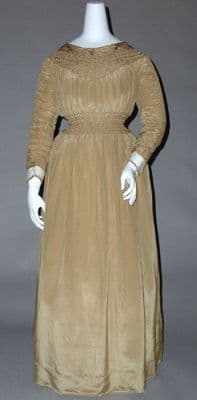
Golden Tan Silk High-Necked A-Line Dress
Fin de Siecle / Gibson Girl · 1890s · British
Production
ready-to-wear
Material
silk
Culture
British
This golden tan silk dress exemplifies 1890s feminine silhouette with its fitted bodice and floor-length A-line skirt. The high neckline features decorative trim or embroidery around the collar and shoulder area. Long fitted sleeves extend to the wrists with what appears to be contrasting cuff details. The bodice is closely fitted through the torso, likely requiring a corset underneath, and transitions to a full skirt that falls in gentle folds to the floor. The silk fabric has a subtle sheen and appears to be a lightweight weave suitable for day wear. The overall construction demonstrates the period's emphasis on a defined waistline and modest coverage while maintaining an elegant feminine form.
dressa-linehigh neckfloor length
Connected To
Worn with·chemiseWorn with·corsetWorn with·petticoatTechnique·hand-embroidery
Worn with·chemiseWorn with·corsetWorn with·petticoatTechnique·hand-embroidery
Worn with·chemiseWorn with·corsetWorn with·petticoatTechnique·hand-embroidery
Worn with·chemiseWorn with·corsetWorn with·petticoat
SHARED10 years · cross-culture
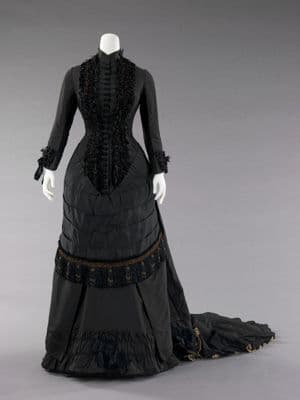
The Victorian bustle dress's cascading black ruffles and the Gibson Girl gown's gathered golden silk represent two sides of the same corset-cinched coin — both demanding the same rigid understructure to achieve their dramatically different silhouettes. Where the earlier dress piles on theatrical frills and trains like armor against propriety, the later gown strips away the fuss for a cleaner, more athletic ideal that still requires the same wasp waist.
Echoes Across Time
Empire / Regency → Fin de Siecle / Gibson Girl · 80yr61%
SHARED
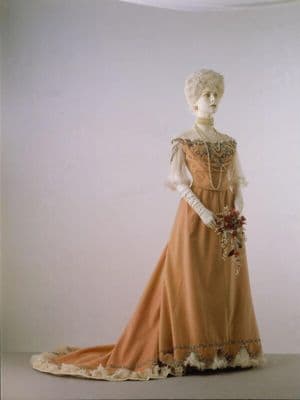
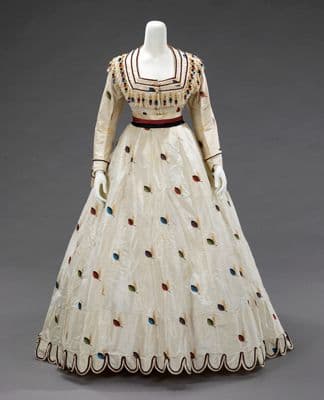
These two gowns reveal how the empire waistline's flattering promise kept drawing designers back across nearly a century of changing silhouettes. The earlier dress places its high waist exactly where Napoleon's court dictated—just beneath the bust, with scattered polka-dot embroidery dancing across acres of silk like confetti on cream—while the later gown lifts its waistline to a more modest rib-cage height, trading Regency abandon for Edwardian restraint.
Worn with·chemiseWorn with·corsetWorn with·petticoat
Pull the Thread→
Follow this garment wherever the graph leads