1950s · 1950s · French
Production
handmade
Material
nylon organza
Culture
French
Movement
New Look · New Look / Post-War
Influences
Christian Dior New Look silhouette
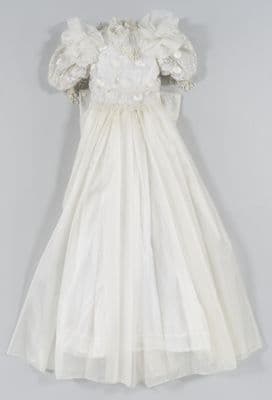
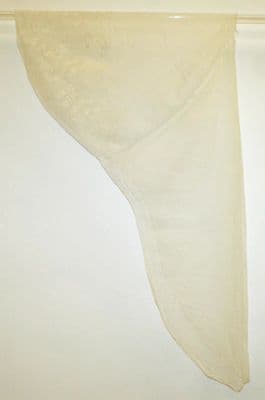
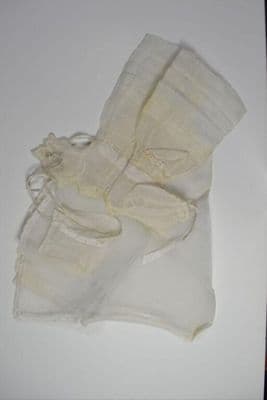
This miniature wedding dress for the French Bleuette doll demonstrates 1950s New Look proportions in diminutive scale. The ivory nylon organza construction features a fitted bodice with what appears to be a sweetheart or scoop neckline, transitioning to a full gathered skirt typical of post-war formal wear. Delicate ribbon ties are visible at the neckline, likely serving both decorative and functional closure purposes. The lightweight, semi-transparent organza creates subtle volume while maintaining the crisp structure characteristic of synthetic fabrics newly popular in the 1950s. The garment's construction reflects the era's return to feminine silhouettes after wartime austerity, translated into doll-scale couture that mirrors adult bridal fashion of the period.


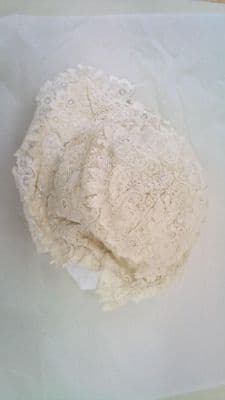
These two wedding pieces reveal how the industrial revolution transformed bridal luxury from painstaking craft to mass-produced fantasy. The Brussels point de gaze cap represents the pinnacle of 19th-century needle lace—each microscopic flower and leaf hand-stitched by Belgian artisans who spent months creating what amounts to wearable architecture in thread.


Follow this garment wherever the graph leads
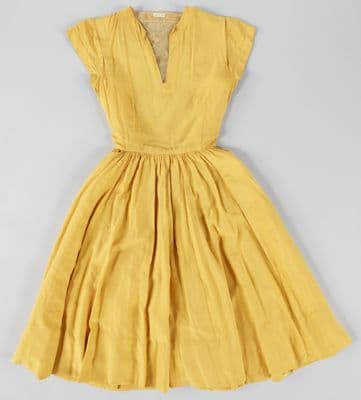
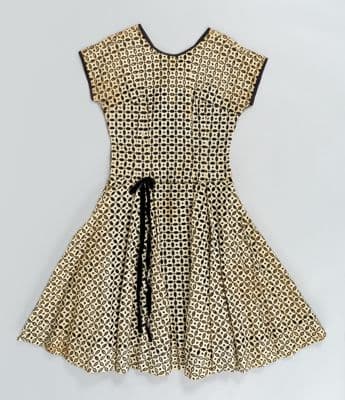
These two 1950s dresses reveal how Dior's New Look traveled from haute couture salons to American ready-to-wear and even into the dollhouse. The yellow dress translates the essential DNA—that cinched waist blooming into a full circle skirt—into cheerful synthetic fabric with practical cap sleeves, while the miniature bridal confection preserves the silhouette's romantic architecture in whisper-thin organza complete with tiny bows.
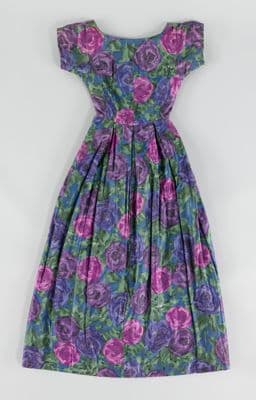
These two 1950s dresses reveal how Dior's New Look traveled across oceans and down social strata, democratizing haute couture's revolutionary silhouette. The purple floral cotton sateen dress translates the French master's nipped waist and full skirt into cheerful American ready-to-wear, while the ivory organza confection—likely made for a doll's trousseau—miniaturizes the same architectural principles into gossamer fantasy.
The towering sleeves of the 1990s gown and the miniature bodice of the 1950s doll dress share the same architectural ambition: organza sculpted into impossible volumes that defy gravity. Both rely on the fabric's peculiar magic—its ability to hold air like a soap bubble—to create drama through sheer structural audacity, whether inflating human shoulders to comic-book proportions or giving a six-inch bride the presence of a cathedral.
These two 1950s pieces reveal how Dior's New Look traveled across oceans and down the age ladder, maintaining its essential DNA while adapting to different markets.