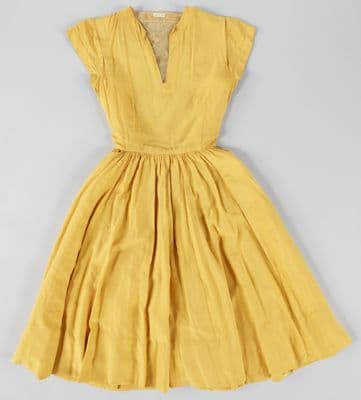
1950s · 1950s · American
Production
ready-to-wear
Material
synthetic fabric
Culture
American
Movement
New Look · New Look / Post-War
Influences
Christian Dior New Look silhouette
A golden yellow day dress featuring the characteristic New Look silhouette with a fitted bodice and full circle skirt that falls to mid-calf length. The dress has short cap sleeves and a deep V-neckline that creates a flattering décolletage. The bodice appears to be fitted through the waist, emphasizing the hourglass figure popular in 1950s fashion. The skirt portion is cut in a full circle or A-line style that would have required crinolines or petticoats underneath to achieve the proper volume and shape. The synthetic fabric appears to have a smooth, possibly cotton-blend texture typical of post-war ready-to-wear garments when new synthetic materials were becoming widely available for everyday clothing.
Follow this garment wherever the graph leads
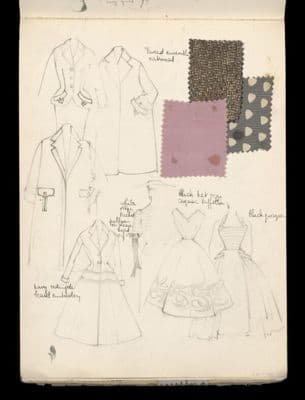
This yellowed sketchbook page captures the exact moment when Dior's New Look was being translated from Parisian haute couture into American ready-to-wear—those quick pencil strokes mapping out the same fitted bodice and full circle skirt that would become the golden dress's DNA.
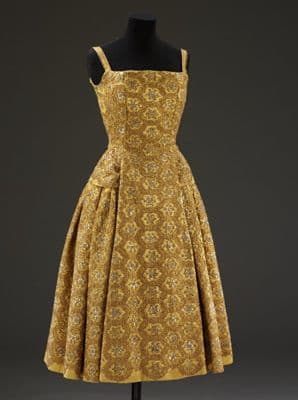
These two golden dresses reveal how Dior's New Look traveled from Parisian couture salons to American ready-to-wear, maintaining its essential DNA while adapting to different markets. The strapless French number, with its luxurious silk satin and intricate brocade pattern, speaks the language of haute couture—notice how the fitted bodice flows into that generous circle skirt with museum-worthy precision.
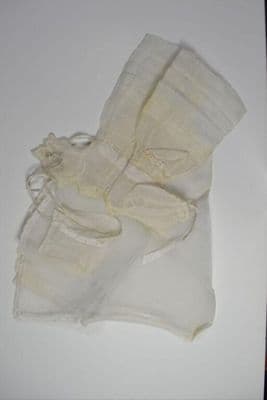
These two 1950s dresses reveal how Dior's New Look traveled from haute couture salons to American ready-to-wear and even into the dollhouse. The yellow dress translates the essential DNA—that cinched waist blooming into a full circle skirt—into cheerful synthetic fabric with practical cap sleeves, while the miniature bridal confection preserves the silhouette's romantic architecture in whisper-thin organza complete with tiny bows.
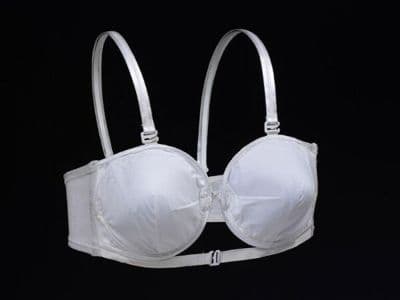
That white bra and yellow dress are engineering partners in the 1950s project of reshaping the female silhouette — one working from the inside, the other from the outside, both committed to the same architectural ideal. The bra's molded cups and sturdy underwire create the pointed, separated bust that gives the dress its proper foundation, while the dress's fitted bodice and full circle skirt demand exactly that kind of structural support beneath.