V&A
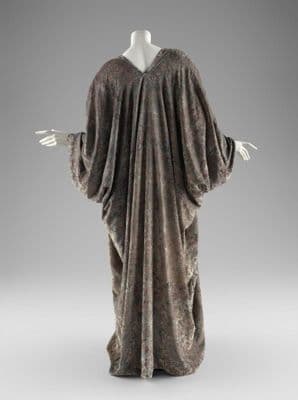
Olive Green Metallic Silk Velvet Caftan
Roaring Twenties / Art Deco · 1920s · Italian
Designer
Mariano Fortuny
Production
artisan-craft
Material
metallic printed silk velvet
Culture
Italian
Movement
Aesthetic Movement
Influences
Ancient Greek chiton · Japanese kimono · Middle Eastern caftan
This flowing caftan displays Mariano Fortuny's signature approach to garment construction, featuring wide kimono-style sleeves that create dramatic horizontal lines when the arms are extended. The silk velvet fabric shows an all-over metallic print with intricate geometric and possibly botanical motifs that catch light across the surface. The garment falls in straight, columnar lines from shoulder to floor, completely obscuring the body's natural silhouette. The deep V-neckline is finished with what appears to be decorative trim or braiding. The construction relies on draping rather than fitted tailoring, with the fabric's weight and fluidity creating the garment's structure. This represents Fortuny's revolutionary approach to women's dress in the 1920s, rejecting corseted construction in favor of ancient-inspired drapery that allowed natural movement while maintaining luxurious materials and surface decoration.
dresstentv-neckfloor length
Connected To
Influences·Middle Eastern caftanTechnique·drapingMotif·abstract-organic
Echoes Across Time
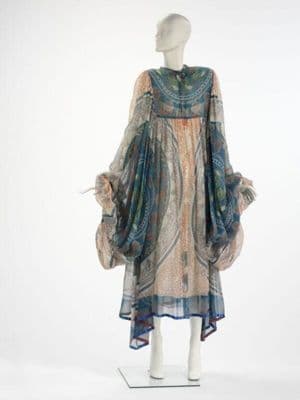
1970s → Roaring Twenties / Art Deco · 40yr70%
SHARED
Both caftans drink from the same well of Orientalist fantasy, but fifty years apart they reveal how Western fashion's Eastern fever dream evolved. The 1920s Italian velvet version clings to Art Deco's geometric precision—those metallic patterns read like a textile translation of a Klimt painting, all angular luxury and Byzantine weight.
Influences·Middle Eastern caftanTechnique·drapingMotif·abstract-organic
Pull the Thread→
Follow this garment wherever the graph leads