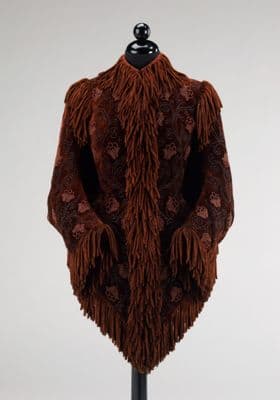
Victorian Late / Bustle · 1880s · American
Production
handmade
Material
silk velvet
Culture
American
Movement
Aesthetic Movement
Influences
Turkish shawl tradition · Moorish textile patterns
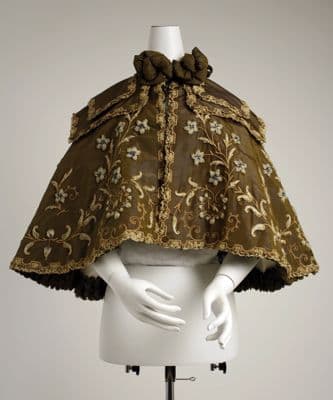
This luxurious evening mantle features rich burgundy silk velvet as the primary fabric with an elaborate geometric pattern woven or embroidered throughout. The garment is constructed as a cape-style wrap with a high collar and dramatic cascading fringe that extends from the neckline down the front edges and around the hemline. The fringe appears to be made of the same silk material, creating substantial textural movement. The overall silhouette is triangular when viewed from the front, typical of 1880s outerwear designed to complement the bustle silhouette underneath. The dense, ornate patterning and heavy fringe demonstrate the Victorian preference for rich surface decoration and substantial materials that conveyed wealth and status.


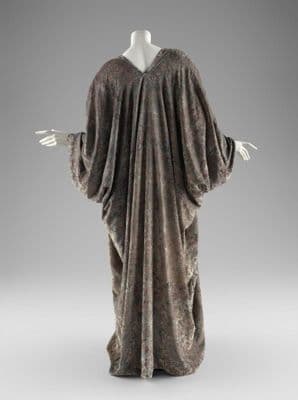
These two velvet mantles speak the same language of Aesthetic Movement sensuality, separated by four decades and an ocean but united by their devotion to the body as sculpture. The Victorian cape's cascading fringe creates the same enveloping, ceremonial drama as the Italian caftan's sweeping sleeves—both garments transform their wearers into walking art objects, rejecting the rigid tailoring of their respective eras for something more fluid and mystical.

Follow this garment wherever the graph leads
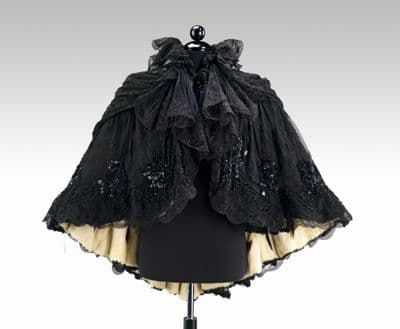
These two evening wraps capture the Victorian obsession with transforming women into walking tapestries, but through distinctly different aesthetic philosophies. The French cape deploys delicate gold florals scattered across olive silk like pressed flowers in a botanical journal, while the American mantle goes full theatrical with burgundy velvet and cascading fringe that would make Oscar Wilde weep with joy.
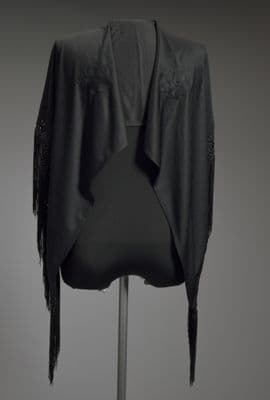
These Victorian evening capes reveal how the same theatrical impulse could manifest in strikingly different vocabularies of luxury. The French cape speaks in whispers—its jet beading catching light like scattered stars against black silk, while the American mantle shouts in burgundy velvet cascades, every surface alive with swinging fringe that would have created a mesmerizing rhythm as the wearer moved.
These two velvet mantles speak the same language of Aesthetic Movement sensuality, separated by four decades and an ocean but united by their devotion to the body as sculpture. The Victorian cape's cascading fringe creates the same enveloping, ceremonial drama as the Italian caftan's sweeping sleeves—both garments transform their wearers into walking art objects, rejecting the rigid tailoring of their respective eras for something more fluid and mystical.
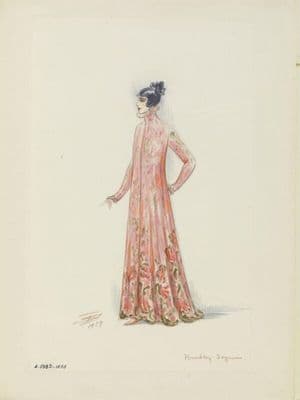
That burgundy velvet mantle, with its cascade of silk fringe and densely embroidered florals, carries the Aesthetic Movement's obsession with medieval romanticism and artisanal craft straight into the 1880s bustle era. Three decades later, the coral evening gown's delicate hand-embroidered botanicals and flowing Empire silhouette show how the same movement's ideals survived the transition to modernity — the obsessive handwork remains, but now it whispers rather than shouts.