V&A
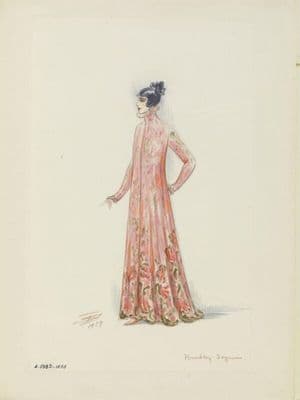
Coral Pink Silk Crepe Empire Waist Evening Gown
World War I Transition · 1910s · British
Designer
Handley-Seymour
Production
one-of-a-kind
Material
silk crepe
Culture
British
Movement
Aesthetic Movement
Influences
Empire waistline revival · Pre-Raphaelite aesthetic dress
This costume design depicts a flowing evening gown with a high empire waistline characteristic of the 1910s silhouette. The garment features a coral pink base with elaborate floral motifs in green and other colors scattered across the fabric. The dress has long fitted sleeves and a dramatically flowing skirt that extends to the floor. The neckline appears modest and high, typical of the period's theatrical costume conventions. The figure wears her dark hair in an upswept style adorned with what appears to be a small ornamental detail. The overall silhouette emphasizes vertical lines and graceful draping, moving away from the more structured corseted forms of the previous Edwardian period toward the softer, more natural lines that would define 1910s fashion.
dressstraighthigh neckfloor length
Connected To
64%
Influences·Empire waistline revival
SHARED10 years · cross-culture
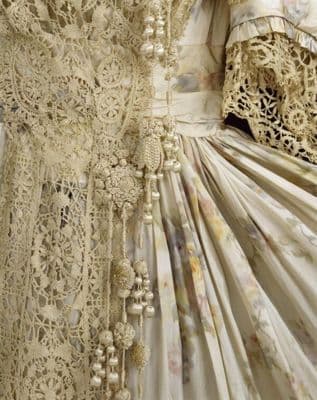
Both gowns ride the same wave of Neoclassical revival that swept through the 1900s and 1910s, but they catch it at different moments. The Edwardian wedding dress, with its empire waist buried under cascades of intricate lace and dimensional florals, still clings to Victorian excess—it's neoclassicism filtered through a maximalist lens.
Echoes Across Time
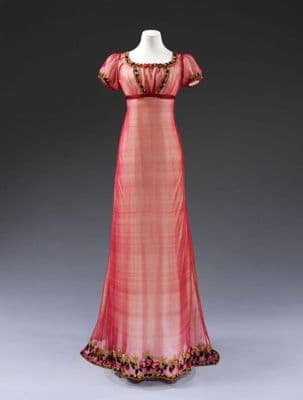
Empire / Regency → World War I Transition · 100yr49%
LINEAGE
That high-waisted Regency gown with its chenille-embroidered florals at the hem and the WWI-era sketch both tap into the Empire line's genius for creating elegance through strategic placement—one anchors its decorative weight at the bottom with those lush botanical motifs, while the other distributes pattern across the entire length of coral silk.
Technique·hand-embroidery
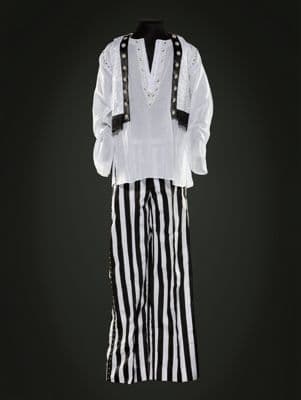
1990s → World War I Transition · 100yr40%
Pull the Thread→
Follow this garment wherever the graph leads