V&A
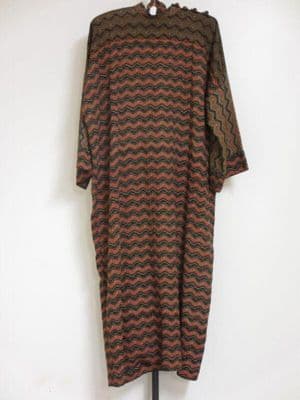
Brown Rust Black Chevron Print Cotton Kaftan
1970s · 1970s · British
Designer
Foale & Tuffin
Production
ready-to-wear
Material
printed cotton
Culture
British
Movement
Hippie / Counterculture
Influences
Middle Eastern kaftan · 1970s ethnic fashion
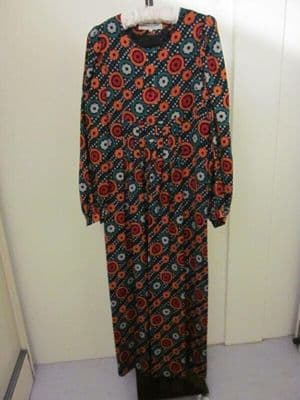
A loose-fitting kaftan dress in printed cotton featuring a continuous chevron zigzag pattern in brown, rust, and black tones. The garment has a straight, boxy silhouette that falls to approximately mid-calf length with wide three-quarter sleeves. The neckline appears to be a simple round or boat neck with minimal finishing. The geometric chevron pattern creates horizontal bands across the entire surface of the fabric, giving visual movement to the otherwise simple construction. This represents the early 1970s embrace of relaxed, ethnic-inspired silhouettes and bold graphic prints that moved away from the structured tailoring of previous decades.
dresstentround neckmidi
Connected To
Movement·Hippie / Counterculture
LINEAGEsame era · cross-culture→ directed
Lineage: “traditional Middle Eastern kaftan”
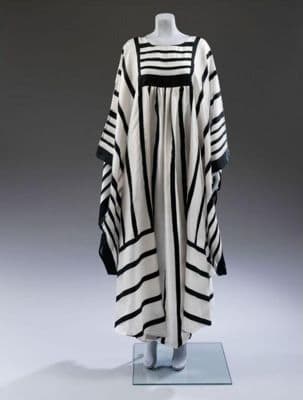
These two kaftans capture the 1970s counterculture's hunger for "authentic" dress, but reveal the gap between appropriation and origin. The brown chevron piece represents Western fashion's digest version of Middle Eastern robes—scaled down to midi length, printed with geometric motifs that feel more Marimekko than Marrakech.

Pull the Thread→
Follow this garment wherever the graph leads