Empire / Regency · 1800s-1810s · American
Production
handmade
Material
striped linen
Culture
American
Influences
neoclassical simplicity · English Regency menswear
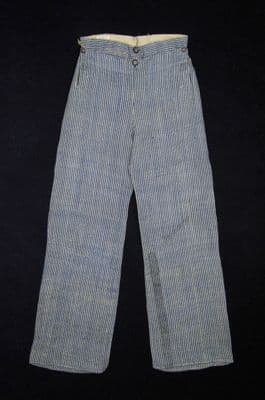
High-waisted men's trousers in blue and white striped linen featuring a distinctive Empire-era silhouette. The trousers sit well above the natural waistline with a fitted waistband secured by buttons at the front fall closure. The legs are cut straight and relatively narrow, tapering slightly toward the ankle in the fashionable Regency style. The striped pattern runs vertically in narrow, even bands typical of early 19th-century textile production. The construction shows period-appropriate tailoring with clean lines and minimal ornamentation, reflecting the neoclassical aesthetic of the era when men's fashion emphasized simplicity and natural proportions over the elaborate decoration of previous decades.


These two garments speak the same language of linen practicality, separated by decades and an ocean but united in their commitment to breathable, workable cloth. The French waistcoat's tiny floral sprigs scattered across cream linen and its body-conscious tailoring represent the Rococo's delicate domesticity, while the American trousers' bold blue stripes and high-waisted practicality announce the new republic's preference for clean geometry over ornamental fuss.


Follow this garment wherever the graph leads
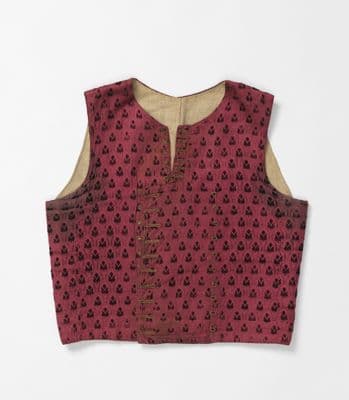
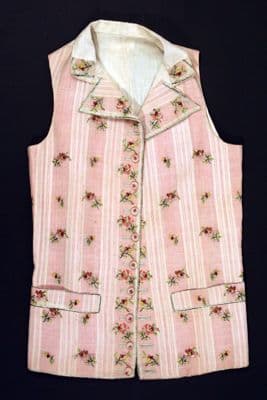
These two garments capture the precise moment when menswear shed its peacock plumage for democratic restraint. The waistcoat's delicate pink silk scattered with tiny floral sprigs represents the final gasp of 18th-century masculine ornament, while those high-waisted striped trousers—with their clean lines and workmanlike linen—signal the new century's embrace of bourgeois sobriety.
These two garments capture the Empire period's obsession with linear precision, whether traced in the crisp blue pinstripes that run the length of those high-waisted trousers or densely stippled across the burgundy silk of this waistcoat in tiny geometric dots.
These two garments speak the same language of linen practicality, separated by decades and an ocean but united in their commitment to breathable, workable cloth. The French waistcoat's tiny floral sprigs scattered across cream linen and its body-conscious tailoring represent the Rococo's delicate domesticity, while the American trousers' bold blue stripes and high-waisted practicality announce the new republic's preference for clean geometry over ornamental fuss.
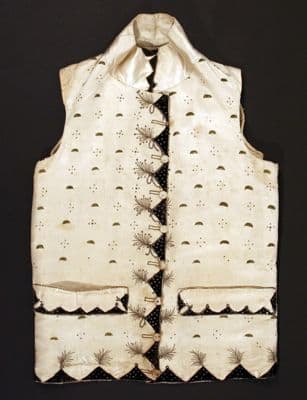
These two garments capture the radical shift from Rococo excess to Neoclassical restraint that swept through men's fashion between the 1750s and 1820s. The French waistcoat, with its ivory silk brocade scattered with delicate motifs and elaborate scalloped edges, represents the ornamental peak of 18th-century court dress—every surface decorated, every edge articulated with precious metallic trim.