V&A
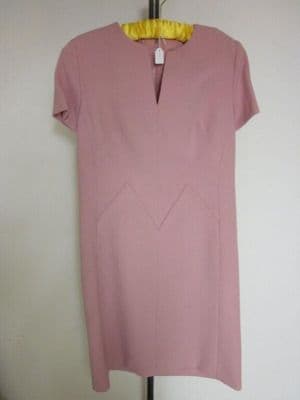
Dusty Rose Wool Crepe Shift Dress
1990s · 1970s · British
Designer
Michael Donéllan
Production
ready-to-wear
Material
wool crepe
Culture
British
Movement
Minimalism
Influences
1960s mod shift dress · minimalist geometric seaming
A simple shift dress in dusty rose wool crepe featuring a straight, unfitted silhouette that falls to mid-thigh length. The dress has short sleeves and a round neckline with a small keyhole opening at the center front secured by a button closure. Two diagonal seaming lines create subtle geometric detailing across the front bodice, forming an inverted V-shape that adds visual interest to the otherwise minimalist design. The wool crepe fabric appears to have a matte finish with a slight texture. The construction reflects early 1970s ready-to-wear sensibilities with clean lines and understated tailoring that moves away from the more structured silhouettes of the previous decade.
dressstraightv-neckabove-the-knee
Connected To
Influences·1960s mod shift dress
SHARED50 years · cross-culture
The teal dress's clean A-line and that crisp geometric circle print are pure 1960s mod revival, while the dusty rose shift carries the same DNA but filtered through '90s minimalism—notice how both hit at nearly identical lengths and share that same sleek, collarbone-skimming neckline.
Echoes Across Time

2010s → 1990s · 50yr62%
SHARED
The teal dress's clean A-line and that crisp geometric circle print are pure 1960s mod revival, while the dusty rose shift carries the same DNA but filtered through '90s minimalism—notice how both hit at nearly identical lengths and share that same sleek, collarbone-skimming neckline.
Influences·1960s mod shift dress

2000s → 1990s · 40yr61%
SHARED
Pull the Thread→
Follow this garment wherever the graph leads