1970s · 1970s · American
Production
ready-to-wear
Material
polyester knit
Culture
American
Movement
Hippie / Counterculture
Influences
1960s mod shift dress · layered blouse-and-jumper styling
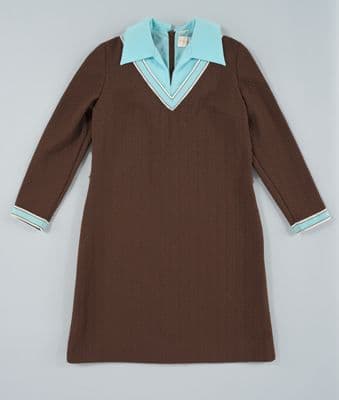
A straight-cut shift dress in chocolate brown polyester knit featuring a distinctive light blue collar and cuff treatment. The dress has a simple A-line silhouette that falls to approximately knee length with long sleeves. The collar is constructed as a separate piece in contrasting light blue fabric, creating a layered effect that mimics a blouse worn underneath. The same blue fabric appears at the sleeve cuffs, creating visual continuity. The neckline forms a deep V-shape where the collar meets. The construction appears to be machine-sewn with clean, commercial finishing typical of ready-to-wear garments from this period. The knit fabric would have provided comfortable stretch and ease of movement.
These two dresses trace a direct line from the 1970s polyester revolution to today's ponte knit sophistication, both mining the same mid-century mod silhouette but with vastly different ambitions. The brown vintage piece, with its crisp aqua collar and cuffs mimicking a layered shirt, represents that era's democratic promise—synthetic fabrics making chic accessible to everyone who shopped at Sears.


These two dresses trace a direct line from the 1970s polyester revolution to today's ponte knit sophistication, both mining the same mid-century mod silhouette but with vastly different ambitions. The brown vintage piece, with its crisp aqua collar and cuffs mimicking a layered shirt, represents that era's democratic promise—synthetic fabrics making chic accessible to everyone who shopped at Sears.


Follow this garment wherever the graph leads

Both dresses speak the same modernist language of the shift—that revolutionary 1960s silhouette that freed women from waist-cinching constructions—but they're separated by decades and entirely different cultural moments. The brown polyester number from the 1970s carries forward mod's graphic sensibility through its crisp blue collar and cuff details, a kind of color-blocked geometry that feels almost architectural.
The yellow dress's clean A-line silhouette and mini length echo the mod revolution that birthed the brown knit shift fifty years earlier, but where the '70s piece doubles down on geometric contrast—that sharp blue collar and cuffs slicing through chocolate brown like a color-blocked manifesto—the contemporary dress strips away the details for pure form.
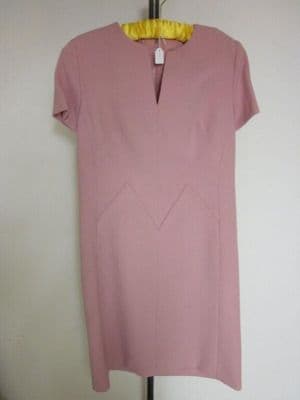
These two shifts trace a direct line from the mod revolution's geometric precision, but where the brown dress still clings to the 1960s playbook with its contrast collar and cuffs mimicking a layered look, the dusty rose piece strips away all the fussy details for pure minimalism.
Both dresses speak the same modernist language of the shift—that revolutionary 1960s silhouette that freed women from waist-cinching constructions—but they're separated by decades and entirely different cultural moments. The brown polyester number from the 1970s carries forward mod's graphic sensibility through its crisp blue collar and cuff details, a kind of color-blocked geometry that feels almost architectural.