SMITHSONIAN
Deep Red Wool Paisley Kashmir Shawl
Empire / Regency · 1800s · Indian
Production
handmade
Material
wool
Culture
Indian
Influences
Kashmir shawl tradition
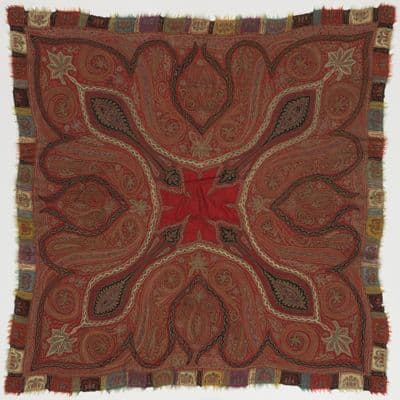
This square wool shawl displays the characteristic paisley motifs arranged in symmetrical formation around a central medallion. The deep red ground is enriched with intricate woven paisley forms in burgundy and cream, creating a radiating pattern that flows from the center outward. The paisley motifs show the classic teardrop shape with internal scrollwork and botanical details. A decorative border frames the entire piece with alternating colored bands and fringe edging. The weaving technique demonstrates the sophisticated Kashmir tradition, with fine wool creating subtle color gradations within each motif. The shawl's square format and scale indicate it was designed for draping over the shoulders as fashionable outerwear during the early 19th century.
scarf
Connected To
Influences·Kashmir shawl traditionTechnique·hand-weavingTechnique·tapestryFunction·formal-eveningMotif·paisley
SHARED30 years
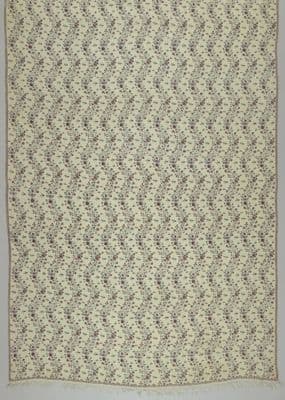
These two Kashmir shawls reveal how the paisley motif evolved from sacred geometry to romantic ornament across three decades of European fascination with Indian textiles. The earlier red shawl commands attention with its bold, architectural paisley that radiates from a central medallion like a mandala—each teardrop form dense with intricate detail and spiritual weight.
Text
Influences·Kashmir shawl traditionFunction·formal-eveningMotif·paisley
SHARED110 years · cross-culture
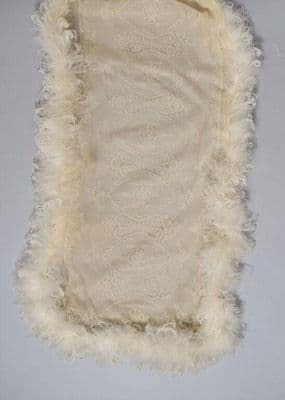
These two pieces reveal how the paisley motif traveled from Kashmir looms to European luxury, transforming along the way. The red wool shawl displays the full-throated maximalism of authentic Kashmir work—those dense, interlocking teardrops creating a hypnotic mandala that commands attention from across a ballroom.
Influences·Kashmir shawl traditionTechnique·hand-weaving
SHARED50 years · cross-culture
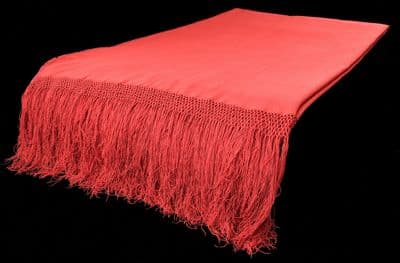
The ornate paisley Kashmir shawl and Susan B. Anthony's plain red silk shawl represent the beginning and end of a cultural journey—the first shows the intricate boteh motifs and complex weaving that made Indian shawls the ultimate luxury accessory of the early 1800s, while Anthony's austere version strips away all ornament, keeping only the essential silhouette and that signature fringe.
Influences·Kashmir shawl traditionMotif·paisley
SHARED20 years · cross-culture
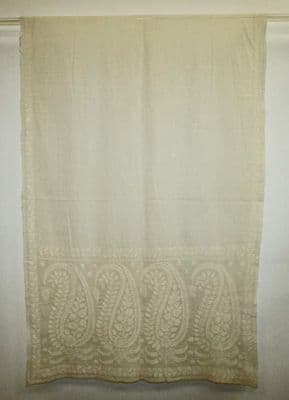
The cream cotton scarf's delicate paisley border is a direct descendant of the red Kashmir shawl's bold, swirling boteh motifs, but stripped of all the drama that made the original so coveted. Where the Kashmir piece commands attention with its deep crimson ground and complex interlocking paisleys that seem to pulse outward from the center, the cotton version whispers—relegating the same teardrop forms to a modest hem treatment in barely-there embroidery.
Pull the Thread→
Follow this garment wherever the graph leads