Edwardian · 1910s · American
Production
handmade
Material
silk crepe
Culture
American
Influences
Edwardian mourning dress conventions · tiered skirt construction
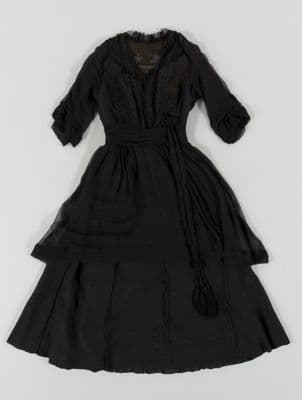
A black silk crepe dress featuring a fitted bodice with three-quarter sleeves and elaborate textural embellishment across the chest and shoulders. The garment displays characteristic Edwardian proportions with a defined waistline emphasized by a fabric belt with tasseled ties. The skirt falls in multiple graduated tiers, creating volume through layered construction rather than structured undergarments. The surface treatment appears to include raised embroidery or appliqué work in matching black thread, creating dimensional patterns across the bodice. The overall silhouette reflects the transitional period of the 1910s, moving away from the extreme S-curve of earlier Edwardian fashion toward a more columnar line while maintaining the era's preference for elaborate surface decoration.


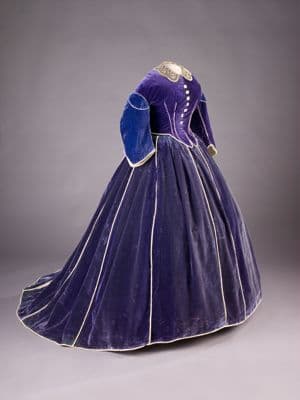
These two dresses reveal how mourning dress evolved from spectacle to subtlety across the Victorian-Edwardian divide. The purple velvet's theatrical sweep—all that trained silk and white lace collar announcing wealth even in grief—gives way to the black dress's quieter sophistication, where embroidered overlay and tiered ruffles create texture without the earlier era's bombast.
Follow this garment wherever the graph leads
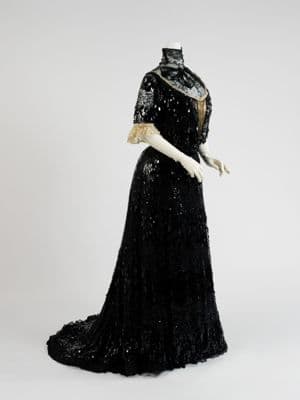
These two dresses reveal how mourning dress evolved from spectacle to subtlety across the Victorian-Edwardian divide. The purple velvet's theatrical sweep—all that trained silk and white lace collar announcing wealth even in grief—gives way to the black dress's quieter sophistication, where embroidered overlay and tiered ruffles create texture without the earlier era's bombast.
The Victorian gown's cascade of jet sequins and the Edwardian dress's intricate black-on-black embroidery represent two generations of the same impulse: using texture to create richness without breaking mourning's chromatic rules. Where the earlier dress relies on light-catching sequins to animate its severe silhouette, the later piece achieves depth through raised needlework that creates shadow and dimension across the bodice and skirt tiers.
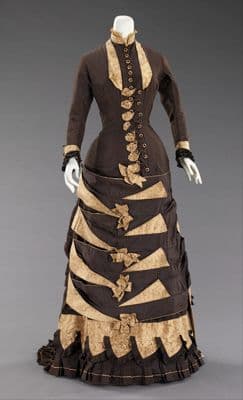
The Victorian bustle dress and Edwardian mourning dress are bound by the theater of grief—both designed for women navigating loss within rigid social protocols. Where the earlier dress announces its mourning status through stark brown-and-tan geometric banding that cuts across the bustle like funeral bunting, the later dress whispers its sorrow through layers of black silk crepe and the tactile grief of hand-embroidered overlay.
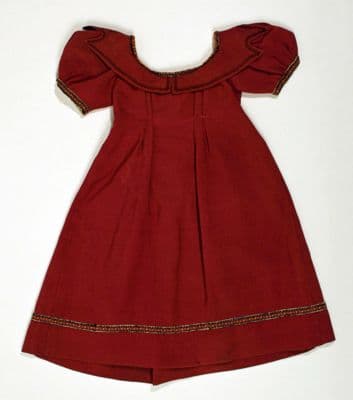
These two dresses speak the same language of feminine propriety across seven decades, both designed to conceal as much as they reveal. The burgundy wool's empire waist and flowing A-line silhouette shares DNA with the black mourning dress's high neckline and voluminous skirt—both use fabric as armor, creating distance between the body and the world through sheer volume and coverage.


The Victorian bustle dress and Edwardian mourning dress are bound by the theater of grief—both designed for women navigating loss within rigid social protocols. Where the earlier dress announces its mourning status through stark brown-and-tan geometric banding that cuts across the bustle like funeral bunting, the later dress whispers its sorrow through layers of black silk crepe and the tactile grief of hand-embroidered overlay.