Victorian Late / Bustle · 1860s · American
Production
one-of-a-kind
Material
silk velvet
Culture
American
Influences
1860s Civil War era formality · European court dress traditions
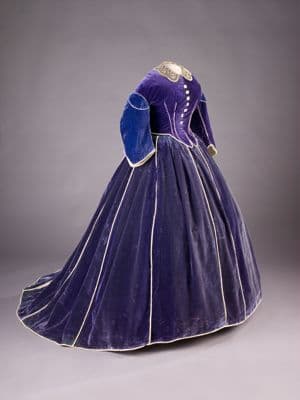
This formal gown features a deep purple silk velvet construction with a fitted bodice that extends to a pointed waist. The bodice displays decorative button closure down the center front and cream-colored trim at the neckline and cuffs. The sleeves are fitted through the arm with slight gathering at the shoulder. The skirt extends into a full, ground-length silhouette with a train, characteristic of 1860s formal wear. White lace or fabric trim accents the neckline in a wide collar formation. The overall construction demonstrates mid-19th century American formal dressmaking with its emphasis on rich materials, structured fit, and ceremonial proportions suitable for White House social functions.
Follow this garment wherever the graph leads
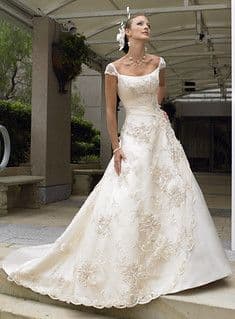
The Victorian velvet gown's dramatic train and the 1950s taffeta ball gown both speak the same language of ceremonial grandeur, where fabric volume becomes a form of architectural power dressing.
That Victorian velvet gown's fitted bodice and sweeping train established the DNA for bridal grandeur that survives in today's cathedral-length confections. Both dresses understand that true formality requires a certain amount of real estate — the purple gown's bustle-supported cascade and the contemporary ballgown's organza expanse both demand you move differently, slower, with intention.
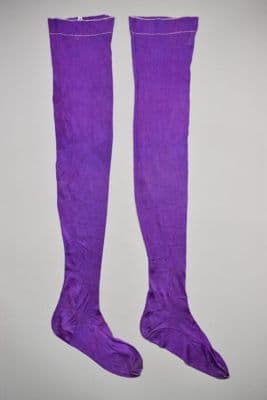
That sumptuous purple velvet gown with its cascading train and tight-buttoned sleeves required an entire architecture of undergarments to achieve its silhouette, including silk stockings like these jewel-toned beauties that would have been completely hidden beneath layers of petticoats.
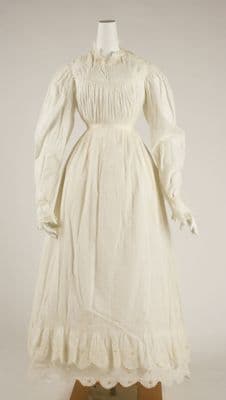
The purple velvet gown's severe geometry—that razor-sharp shoulder line dropping into a perfect bell—couldn't look more different from the cream dress's soft gathering and romantic ruffles, yet both are masterclasses in Victorian feminine architecture. Where the earlier dress whispers with its delicate pintucks and scalloped hem, the later gown commands with military precision: those gleaming buttons marching down the bodice like a general's dress uniform translated into silk velvet.

That Victorian velvet gown's fitted bodice and sweeping train established the DNA for bridal grandeur that survives in today's cathedral-length confections. Both dresses understand that true formality requires a certain amount of real estate — the purple gown's bustle-supported cascade and the contemporary ballgown's organza expanse both demand you move differently, slower, with intention.