SMITHSONIAN
Deep Burgundy Silk Velvet Textile Fragment
Italian Renaissance · 1500s · Italian
Production
artisan-craft
Material
silk velvet
Culture
Italian
Influences
Byzantine silk traditions · Islamic textile patterns
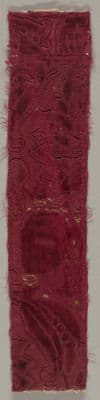
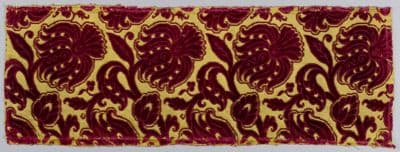
This narrow textile fragment displays the rich burgundy silk velvet characteristic of Italian Renaissance luxury textiles. The surface shows a complex woven or cut velvet pattern with flowing, organic motifs that appear to include stylized foliage or vine-like elements. The deep pile of the velvet creates subtle variations in tone and light reflection across the surface. The fragment's edges show signs of age and wear, with some fraying visible along the borders. The dense, lustrous quality of the silk velvet and the sophisticated patterning reflect the high level of textile craftsmanship achieved in 16th-century Italian workshops, particularly those of Venice and Florence.
Connected To
Influences·Byzantine silk traditionsInfluences·Islamic textile patternsTechnique·hand-weaving
SHARED100 years · cross-culture · cross-category
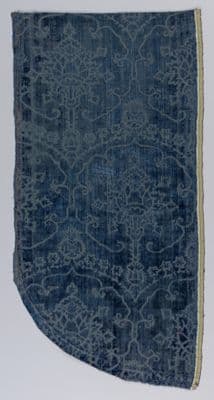
These two velvet fragments reveal how Renaissance luxury textiles evolved from their medieval predecessors while maintaining the same DNA of Byzantine-inspired grandeur. The burgundy Italian piece shows the Renaissance refinement of the pomegranate motif—those bulbous, symmetrical forms that became shorthand for aristocratic taste—while the blue fragment displays the earlier, more geometric interpretation of similar palatial patterns.
Text78%
Image75%
Influences·Islamic textile patternsTechnique·hand-weavingFunction·court-formal
SHARED100 years · cross-culture
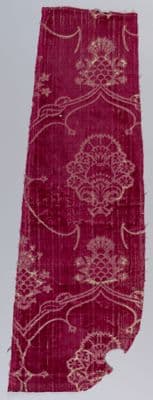
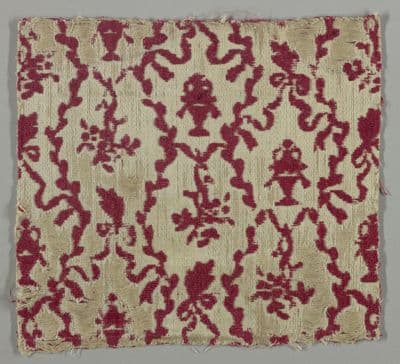
These two burgundy velvet fragments reveal how Islamic textile patterns infiltrated European courts through different routes and centuries. The earlier medieval piece shows the more geometric, stylized palmettes and interlacing typical of Mamluk influence, while the Renaissance fragment displays the looser, more naturalistic foliage that emerged as Italian weavers absorbed and reinterpreted Eastern motifs through direct trade contact.
Technique·hand-weavingTechnique·velvet-cuttingMotif·abstract-organic
SHARED100 years · cross-culture
These two burgundy velvets reveal how the Renaissance appetite for luxurious surface traveled from Italian workshops to English courts, but with telling differences in execution. The Italian fragment shows the dense, saturated pile that made Venetian velvets legendary—every fiber seems to drink light, creating that signature Renaissance richness where pattern and ground merge in shadowy opulence.
54%
Technique·hand-weavingTechnique·velvet-cutting
SHARED200 years
Text91%
Echoes Across Time
Italian Renaissance → Late Medieval · 100yr80%
SHARED
These two velvet fragments reveal how Renaissance luxury textiles evolved from their medieval predecessors while maintaining the same DNA of Byzantine-inspired grandeur. The burgundy Italian piece shows the Renaissance refinement of the pomegranate motif—those bulbous, symmetrical forms that became shorthand for aristocratic taste—while the blue fragment displays the earlier, more geometric interpretation of similar palatial patterns.
Influences·Byzantine silk traditionsInfluences·Islamic textile patternsTechnique·hand-weaving
Pull the Thread→
Follow this garment wherever the graph leads