SMITHSONIAN
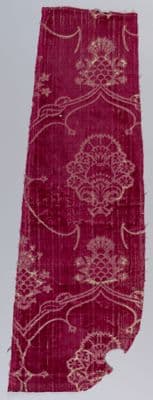
Deep Burgundy Silk Velvet Fragment with Gold
Late Medieval · 1400s · Western European
Production
artisan-craft
Material
silk velvet
Culture
Western European
Influences
Islamic textile patterns · Italian silk weaving traditions
This silk velvet fragment displays the characteristic luxury textile production of late medieval Europe. The deep burgundy ground features an elaborate woven pattern in gold thread, showing large-scale palmette or artichoke motifs arranged in a formal repeat. The velvet pile creates rich texture and depth, while the metallic threads catch light to emphasize the ornamental design. The pattern shows Islamic-influenced decorative vocabulary that was popular in European luxury textiles of this period, likely produced in Italian weaving centers. The fragment's worn edges and partial motifs suggest it was cut from a larger ceremonial garment or furnishing textile.
Connected To
Influences·Islamic textile patternsTechnique·hand-weavingFunction·court-formal
SHARED100 years · cross-culture
These two burgundy velvet fragments reveal how Islamic textile patterns infiltrated European courts through different routes and centuries. The earlier medieval piece shows the more geometric, stylized palmettes and interlacing typical of Mamluk influence, while the Renaissance fragment displays the looser, more naturalistic foliage that emerged as Italian weavers absorbed and reinterpreted Eastern motifs through direct trade contact.
Text92%
Image79%
Function·court-formalMotif·medallion
SHARED400 years · cross-culture · cross-category
Text53%
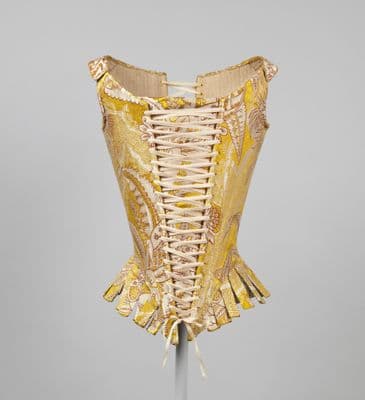
Technique·brocade-weavingFunction·court-formal
SHARED370 years · cross-culture · cross-category
Text64%
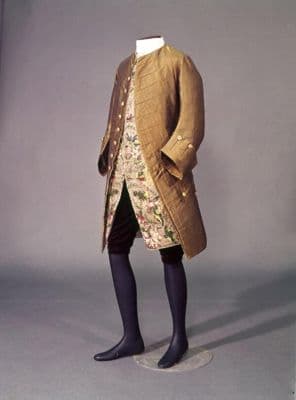
Technique·brocade-weavingFunction·court-formal
SHARED340 years · cross-culture · cross-category
Text62%
Echoes Across Time
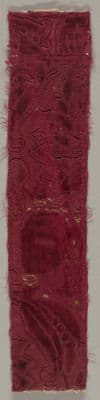
Late Medieval → Italian Renaissance · 100yr71%
SHARED
These two burgundy velvet fragments reveal how Islamic textile patterns infiltrated European courts through different routes and centuries. The earlier medieval piece shows the more geometric, stylized palmettes and interlacing typical of Mamluk influence, while the Renaissance fragment displays the looser, more naturalistic foliage that emerged as Italian weavers absorbed and reinterpreted Eastern motifs through direct trade contact.
Influences·Islamic textile patternsTechnique·hand-weavingFunction·court-formal
Pull the Thread→
Follow this garment wherever the graph leads