SMITHSONIAN
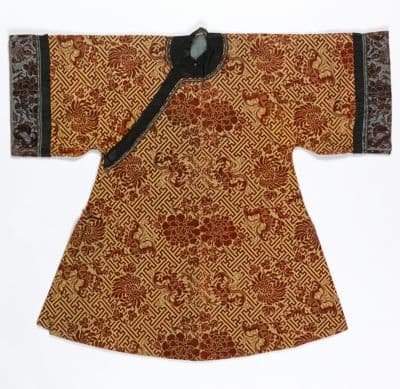
Rust Red Silk Velvet Chinese Robe
Victorian Early / Crinoline · 1850s · Chinese
Production
handmade
Material
silk velvet
Culture
Chinese
Influences
traditional Chinese robe construction · Qing dynasty textile patterns
This Chinese women's robe features a traditional T-shaped silhouette with wide, straight sleeves and a wrap-front closure secured with black ties. The garment is constructed from rust-red silk velvet with an intricate all-over geometric pattern in gold thread, creating a dense lattice design interspersed with stylized floral motifs. The sleeves are edged with dark brown or black silk bands that provide contrast and structural definition. The robe falls to approximately mid-calf length and demonstrates the characteristic Chinese approach to garment construction with minimal shaping and emphasis on textile surface decoration rather than fitted tailoring.
dressstraightknee length
Connected To
Worn with·undergarmentsTechnique·couture-constructionTechnique·hand-embroidery
SHARED120 years · cross-culture
Both garments speak the same language of painstaking hand-embroidery, but where the Chinese robe deploys its geometric patterns like armor across rust-red silk velvet, the 1970s ensemble whispers its decorative intent through delicate white-on-white work that catches light rather than commanding it.
Worn with·undergarmentsTechnique·couture-constructionTechnique·hand-embroidery
SHARED80 years · cross-culture
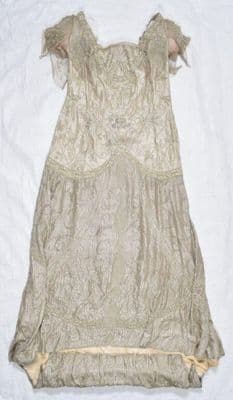
These two garments reveal how luxury announces itself through surface richness, whether in the Depression-era lamé gown's shimmering metallic weave or the Chinese robe's dense geometric brocade that catches light like hammered metal. Both rely on textile as theater—the gown's glass pearls and the robe's intricate woven patterns create visual weight that transforms the wearer into a walking artwork.
Worn with·undergarmentsTechnique·couture-construction
SHARED100 years · cross-culture
Text63%
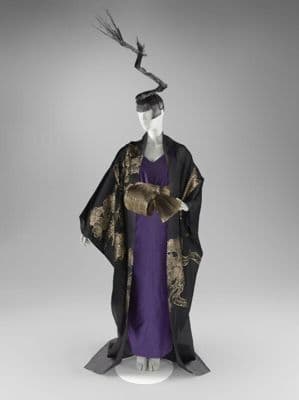
Technique·couture-constructionTechnique·hand-embroideryFunction·religious-ceremonial
SHARED160 years · cross-culture
Echoes Across Time
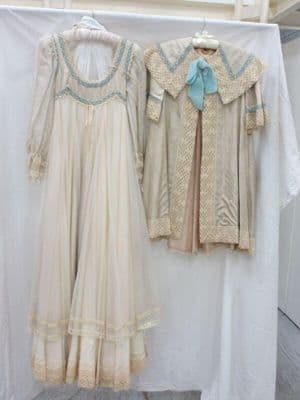
Victorian Early / Crinoline → 1970s · 120yr58%
SHARED
Both garments speak the same language of painstaking hand-embroidery, but where the Chinese robe deploys its geometric patterns like armor across rust-red silk velvet, the 1970s ensemble whispers its decorative intent through delicate white-on-white work that catches light rather than commanding it.
Worn with·undergarmentsTechnique·couture-constructionTechnique·hand-embroidery
Pull the Thread→
Follow this garment wherever the graph leads