V&A
Ivory Lace Waspie Corset Belt
1950s · 1950s · French
Designer
Jacques Griffe
Production
haute couture
Material
cotton or silk lace
Culture
French
Movement
New Look · New Look / Post-War
Influences
Christian Dior New Look wasp waist · Victorian corsetry revival
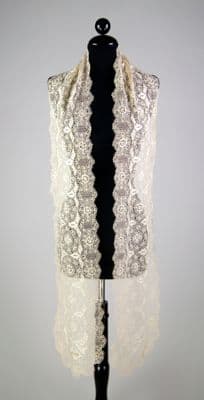
A curved waspie or corset belt constructed from fine ivory lace with a structured foundation. The garment features a distinctive curved silhouette designed to cinch the waist, with pointed extensions at the front center and back that create an hourglass shape. The lace appears to be machine-made with a delicate floral or geometric pattern. The construction shows internal boning or structured support to maintain the curved form. This undergarment component would have been worn over a dress or with separates to create the emphasized waist silhouette characteristic of 1950s New Look fashion, providing the foundation for the era's dramatic hourglass figure.
dressfit and flarefloor length
Connected To
Movement·New LookMovement·New Look / Post-WarWorn with·petticoat
Echoes Across Time
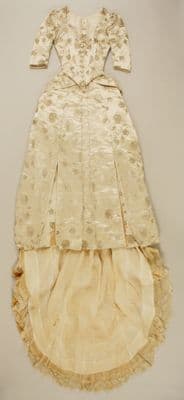
Victorian Late / Bustle → 1950s · 70yr55%
SHARED
These two pieces reveal how the French obsession with waist manipulation evolved from architectural drama to subtle seduction. The Victorian gown's fitted bodice creates that signature bustle-era silhouette through rigid boning and precise tailoring, while the 1950s waspie achieves the same cinched effect with delicate lace stretched over a foundation—both demanding the same engineering precision, just seventy years apart.
Worn with·petticoatTechnique·couture-constructionFunction·court-formal
Pull the Thread→
Follow this garment wherever the graph leads