V&A
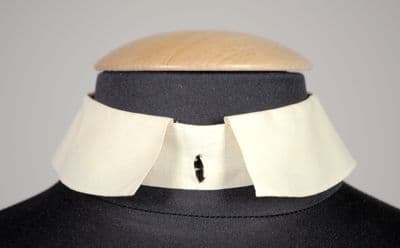
Starched White Cotton Wing Collar
Roaring Twenties / Art Deco · 1920s · British
Designer
Osborn
Production
ready-to-wear
Material
starched cotton
Culture
British
Influences
Victorian formal collar tradition
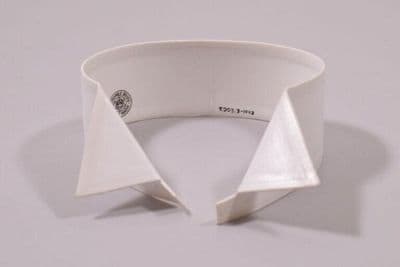
A crisp white starched cotton wing collar featuring the characteristic pointed wing tips that fold down at angles from the band. The collar maintains a rigid, sculptural form due to heavy starching, creating sharp geometric lines. The band sits high on the neck with a front opening, designed to be worn with a separate shirt and secured with collar studs. The wings project outward at precise angles, creating space for a bow tie or formal necktie. This detachable collar represents the formal menswear standard of the 1920s, when such accessories were essential components of proper dress, requiring daily laundering and starching to maintain their architectural precision.
tie
Connected To
Worn with·collar studsWorn with·dress shirt
SHARED40 years · cross-culture · cross-category
These two starched white cotton collars trace the evolution of masculine formality from Victorian practicality to Jazz Age precision. The earlier detachable collar, with its rounded edges and utilitarian buttonhole, was born from an era when laundering a collar was easier than washing an entire shirt—a democratic innovation that let working men maintain crisp necklines without constant shirt changes.
Text82%
Image78%
Entity34%
Worn with·bow tieWorn with·dress shirt
SHARED30 years · cross-culture · cross-category
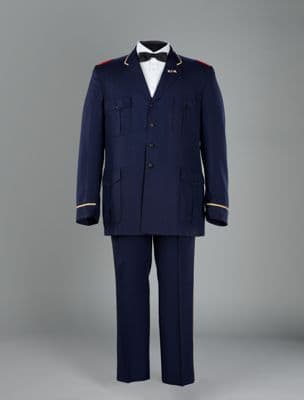
The navy uniform's crisp military collar and the detached wing collar are both engineered for the same purpose: to frame a bow tie with geometric precision. Where the uniform integrates its formal neckline into a complete power structure of brass buttons and regimental details, the wing collar distills that same authoritative gesture into pure white cotton architecture—those sharp, angled points that thrust forward like tiny shields.

Worn with·bow tieWorn with·dress shirt
SHARED90 years · cross-culture · cross-category
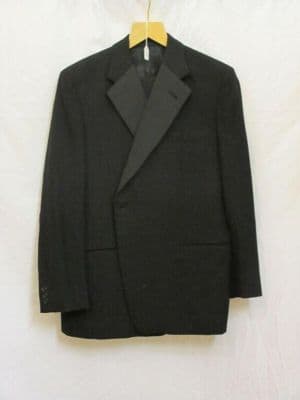
That wing collar's razor-sharp points and architectural stiffness reveal the DNA still pulsing through formal menswear a century later—the same geometric severity that gives this modern tuxedo its knife-edge lapels and body-skimming silhouette. Where the 1920s collar stood like a paper fortress around the neck, demanding perfect posture and social compliance, today's tuxedo achieves the same authoritative effect through its lean, unforgiving cut that tolerates no slouching.
Worn with·bow tieWorn with·dress shirt
SHARED60 years · cross-culture · cross-category
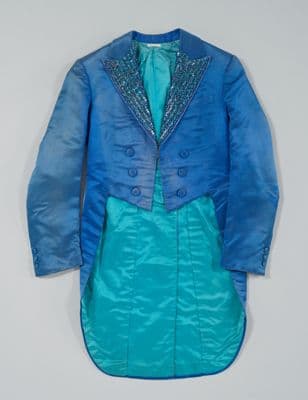
The theatrical tailcoat's razor-sharp lapels, crisp as origami in royal blue satin, echo the geometric aggression of that starched wing collar's jutting points—both pieces weaponizing formal menswear's architecture into something almost violent in its precision.
Pull the Thread→
Follow this garment wherever the graph leads