Victorian Late / Bustle · 1870s · American
Production
haute couture
Material
silk brocade
Culture
American
Influences
1870s bustle silhouette · Second Empire court dress
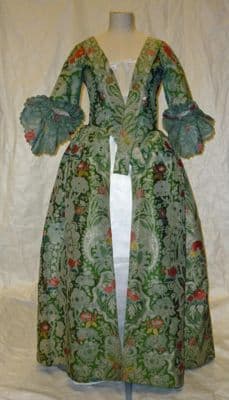
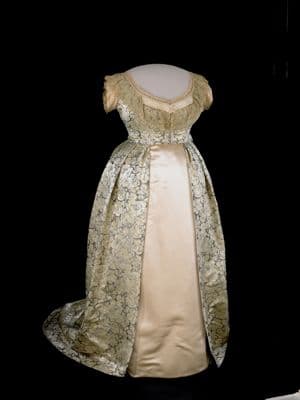
This formal gown features a fitted off-shoulder bodice with short puffed sleeves trimmed in blonde lace or fringe. The sage green silk brocade displays an intricate woven pattern throughout. The construction shows typical 1870s silhouette with a fitted bodice extending to a point at the waist. The overskirt opens in front to reveal a cream silk underskirt, creating the fashionable apron-front effect popular during the bustle era. The overskirt extends into a substantial train, indicating the garment's ceremonial importance. The brocade fabric appears heavy and lustrous, with metallic gold threads creating dimensional floral or geometric motifs across the surface.


These two gowns reveal how the Victorians ransacked the 18th century for inspiration, but couldn't resist improving on it. The earlier English robe flows in unbroken lines from shoulder to floor, its green silk brocade allowed to speak for itself in that confident rococo way, while the later American dress chops up all that fluidity with a fitted bodice, defined waist, and bustled silhouette that screams 1870s propriety.
Follow this garment wherever the graph leads
These two gowns reveal how the Second Empire's taste for theatrical luxury filtered through different social strata across two decades. The earlier brocade ball gown, with its off-shoulder bertha collar and metallic weave catching light like armor, speaks the formal language of Empress Eugénie's court—all glittering surfaces and architectural volume over crinolines.
These two gowns reveal how the Victorians ransacked the 18th century for inspiration, but couldn't resist improving on it. The earlier English robe flows in unbroken lines from shoulder to floor, its green silk brocade allowed to speak for itself in that confident rococo way, while the later American dress chops up all that fluidity with a fitted bodice, defined waist, and bustled silhouette that screams 1870s propriety.
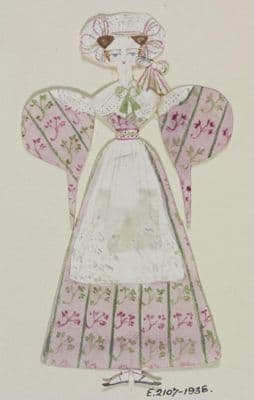
That sage brocade gown with its dropped shoulders and generous train represents the Victorian obsession with opulent surfaces—every inch worked in metallic thread like armor made of light. The watercolor dress, sketched decades earlier, shows the Romantic era's softer approach: those puffy sleeves and floral-sprigged apron speak to a time when women's fashion still flirted with pastoral fantasy rather than imperial grandeur.
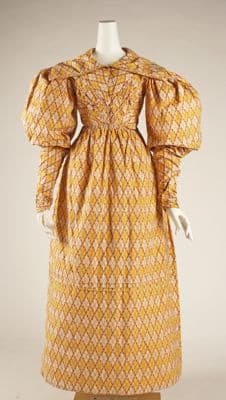
These two dresses reveal how the Romantic era's obsession with volume migrated from sleeve to skirt across fifty years of Victorian silhouette evolution. The earlier golden cotton dress channels all its drama into those magnificent balloon sleeves—gathered, pleated, and structured to create an almost architectural shoulder line that makes the fitted bodice look impossibly tiny by contrast.


That sage brocade gown with its dropped shoulders and generous train represents the Victorian obsession with opulent surfaces—every inch worked in metallic thread like armor made of light. The watercolor dress, sketched decades earlier, shows the Romantic era's softer approach: those puffy sleeves and floral-sprigged apron speak to a time when women's fashion still flirted with pastoral fantasy rather than imperial grandeur.