V&A
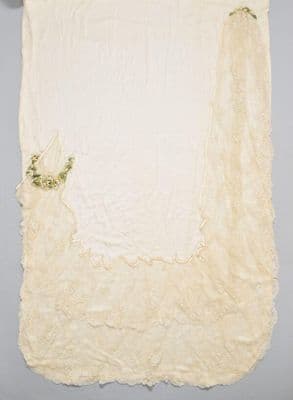
Belgian Bobbin Lace Square Wedding Veil
Victorian Late / Bustle · 1870s · Belgian
Production
handmade
Material
bobbin lace
Culture
Belgian
Influences
Brussels lace tradition · Victorian botanical naturalism
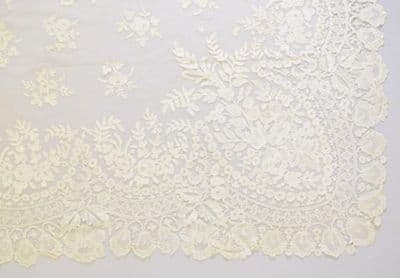
This square wedding veil showcases the intricate artistry of Belgian bobbin lace from the 1870s. The textile displays a sophisticated pattern hierarchy with delicate floral motifs scattered across the field and an elaborate border featuring larger botanical designs. The bobbin lace technique creates raised, three-dimensional flowers and leaves that catch light beautifully. The scalloped edge demonstrates the characteristic undulating border treatment of Victorian lace-making. The cream-colored linen thread work shows the fine gauge typical of Belgian production, with areas of dense filling stitches contrasting against more open mesh grounds. This substantial square format would have draped gracefully over the elaborate hairstyles and bustled silhouettes of 1870s bridal fashion.
headband/head covering/hair accessory
Connected To
Worn with·wedding dressFunction·wedding
SHARED90 years · cross-culture
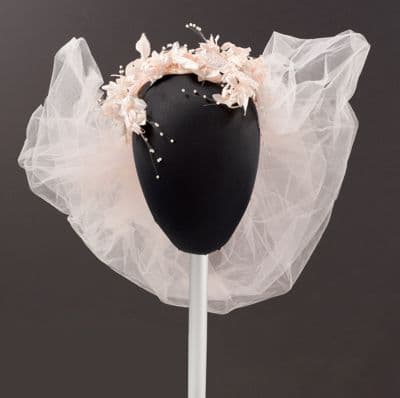
The Victorian lace veil's intricate snowflake motifs, worked in bobbin lace with the precision of a master craftsman, finds its descendant in the 1950s headband's scatter of pearl droplets across machine-made tulle—both using repetitive white-on-white patterning to create bridal luminosity.
Text68%
Image72%
Entity29%
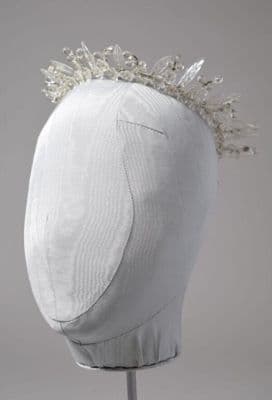
Worn with·wedding dressFunction·wedding
SHARED60 years · cross-culture
These two bridal pieces reveal how economic necessity can reshape luxury traditions with surprising elegance. The Depression-era glass wreath transforms the Victorian veil's delicate botanical motifs—those hand-worked flowers and leaves cascading across Belgian lace—into molded glass spikes that catch light like frozen tears, creating drama from industrial materials when silk thread and hours of handwork were no longer feasible.
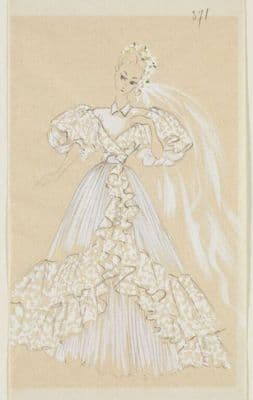
Technique·laceworkFunction·wedding
SHARED70 years · cross-culture · cross-category
Text70%
Technique·laceworkFunction·wedding
SHARED50 years · cross-culture · cross-category
Text63%
Pull the Thread→
Follow this garment wherever the graph leads