Roaring Twenties / Art Deco · 1920s · British
Designer
Lucile
Production
haute couture
Material
silk charmeuse
Culture
British
Influences
Edwardian court train tradition
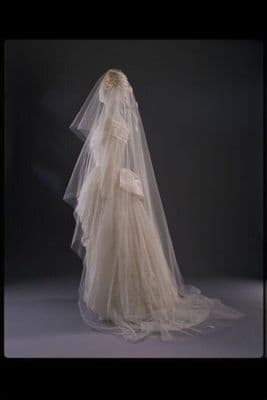
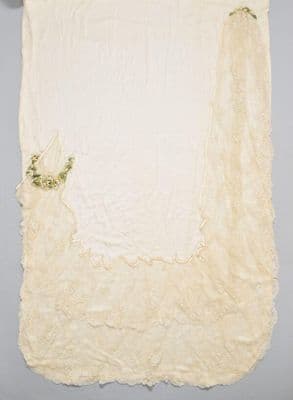
This ivory silk charmeuse wedding train displays the refined luxury characteristic of early 1920s bridal fashion. The train features a long, flowing silhouette that would attach to the waistline of a wedding gown, creating an elegant trailing effect. The surface shows subtle tonal variations and a lustrous finish typical of charmeuse weaving. Delicate lace trim edges the train's perimeter, adding textural contrast to the smooth silk base. The construction appears to involve careful draping and finishing techniques, with the fabric cut to create graceful movement while maintaining structural integrity. This piece represents the transition from Edwardian formality to the more streamlined aesthetic emerging in the 1920s, retaining ceremonial grandeur while embracing the decade's preference for fluid, unstructured silhouettes.


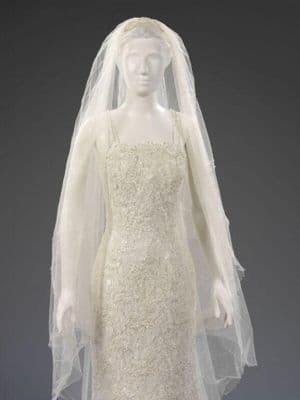
These two pieces trace the evolution of bridal drama from the body outward—the 1920s train hugs close with its liquid silk charmeuse and delicate scalloped edges, creating a puddle of ivory that follows the bride's every step, while the 1990s cathedral veil floats like a cloud, its sheer tulle designed to catch light and air rather than cling to form.
Follow this garment wherever the graph leads
These two pieces trace the evolution of bridal drama from the body outward—the 1920s train hugs close with its liquid silk charmeuse and delicate scalloped edges, creating a puddle of ivory that follows the bride's every step, while the 1990s cathedral veil floats like a cloud, its sheer tulle designed to catch light and air rather than cling to form.
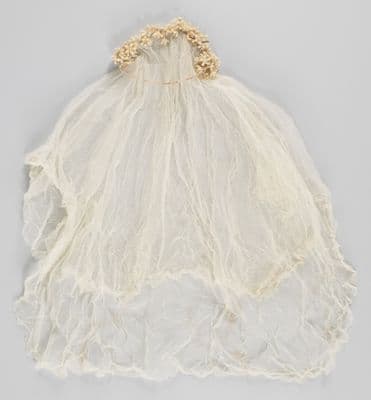
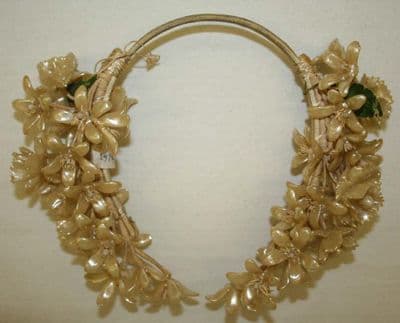
These two pieces capture the Victorian obsession with botanical abundance versus the twenties' embrace of liquid minimalism, yet both understand that a bride needs something extra to mark the moment. The earlier headdress cascades with dimensional silk flowers like a garden exploding from the head, while the later train flows in one unbroken plane of ivory charmeuse, its only ornament a delicate scalloped edge that whispers rather than shouts.
These two bridal pieces reveal how the economic crash of 1929 rewrote wedding luxury in real time. The twenties train flows in liquid silk charmeuse with hand-finished scalloped edges—the kind of extravagant yardage that announced serious family money—while the Depression-era veil makes synthetic net feel precious through delicate cream silk flowers clustered at the crown like a garden rescued from harder times.
These two pieces trace the evolution of bridal drama from the body outward—the 1920s train hugs close with its liquid silk charmeuse and delicate scalloped edges, creating length through fabric that flows like water from the hips, while the 1990s cathedral veil achieves the same theatrical sweep through sheer volume and air. Sixty years apart, they represent opposite approaches to the same desire: that moment when a bride turns and her silhouette fills the entire aisle.


These two pieces capture the Victorian obsession with botanical abundance versus the twenties' embrace of liquid minimalism, yet both understand that a bride needs something extra to mark the moment. The earlier headdress cascades with dimensional silk flowers like a garden exploding from the head, while the later train flows in one unbroken plane of ivory charmeuse, its only ornament a delicate scalloped edge that whispers rather than shouts.