Fin de Siecle / Gibson Girl · 1900s · British
Designer
Jays Ltd.
Production
ready-to-wear
Material
wool
Culture
British
Influences
Gibson Girl silhouette
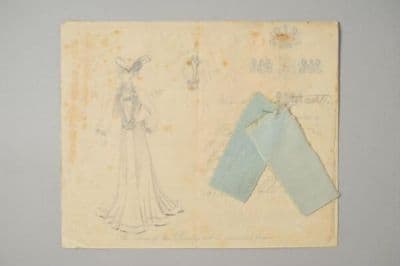
This fashion drawing depicts a travelling gown design from around 1900, featuring the characteristic silhouette of the Gibson Girl era. The sketch shows a fitted bodice with what appears to be a high neckline and long sleeves, paired with a full-length skirt that flares from the waist. The drawing includes technical details and measurements, indicating this was a commercial design document. Two fabric samples are attached to the upper right - one appears to be a pale blue wool and another in a complementary tone. The overall design reflects the practical yet fashionable approach to women's travel clothing at the turn of the century, when long-distance travel required garments that were both stylish and suitable for extended wear.


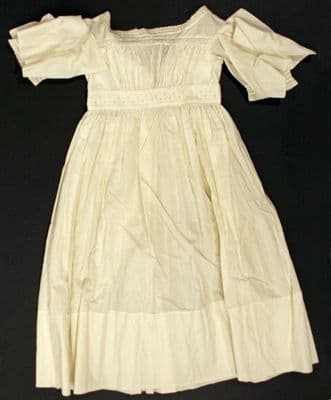
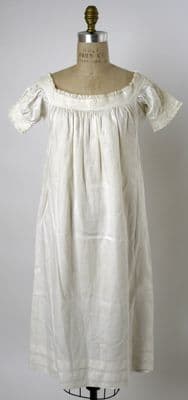
That cream cotton chemise from the 1840s, with its gathered neckline and puffed sleeves drooping like deflated balloons, carries the DNA of Romantic-era innocence — the kind of dress that whispered rather than announced. Sixty years later, the British traveling gown sketched alongside those wool swatches speaks in an entirely different register: streamlined, purposeful, built for a woman who moves through the world rather than waiting in it.
Follow this garment wherever the graph leads
That cream cotton chemise from the 1840s, with its gathered neckline and puffed sleeves drooping like deflated balloons, carries the DNA of Romantic-era innocence — the kind of dress that whispered rather than announced. Sixty years later, the British traveling gown sketched alongside those wool swatches speaks in an entirely different register: streamlined, purposeful, built for a woman who moves through the world rather than waiting in it.
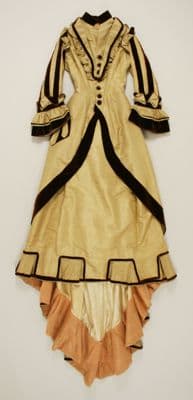
The golden silk dress and the cream wool traveling gown capture the bustle era's evolution from theatrical excess to streamlined practicality. Where the yellow taffeta revels in its architectural drama—that cascading train and sharp black trim announcing wealth and leisure—the cream wool sketch shows fashion's pivot toward the Gibson Girl's active femininity, its A-line suggesting movement rather than display.
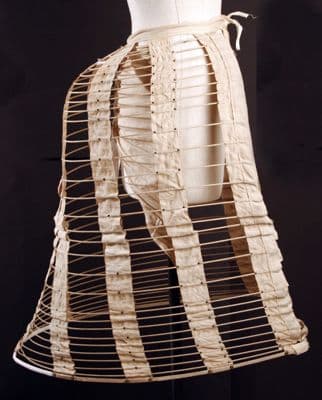
That skeletal bustle cage, all steel ribs and cotton tape ties, is the hidden architecture that made the Gibson Girl silhouette possible — its dramatic bell curve creating the foundation for that cream wool traveling gown's sweeping A-line. The bustle's engineered framework and the dress's soft drape represent two sides of the same Victorian equation: the invisible infrastructure and its visible poetry.
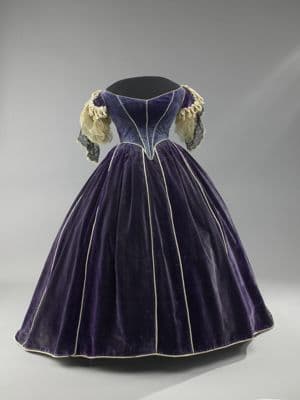
These two pieces capture the Victorian woman's wardrobe at a fascinating inflection point — Mary Todd Lincoln's sumptuous purple velvet bodice with its pagoda sleeves and tight corseting represents the height of mid-century formality, while the cream wool traveling gown's looser A-line silhouette and practical design sketches signal the coming liberation of the Gibson Girl era.


These two pieces capture the Victorian woman's wardrobe at a fascinating inflection point — Mary Todd Lincoln's sumptuous purple velvet bodice with its pagoda sleeves and tight corseting represents the height of mid-century formality, while the cream wool traveling gown's looser A-line silhouette and practical design sketches signal the coming liberation of the Gibson Girl era.