V&A
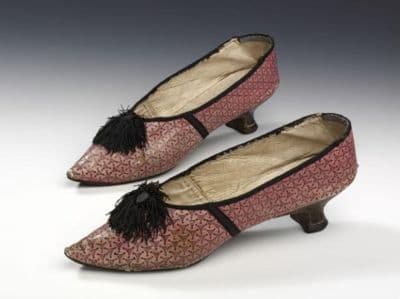
Pink Kid Leather Court Shoes with Black Triangular Pattern
Revolutionary / Directoire · 1780s · British
Production
handmade
Material
kid leather
Culture
British
Influences
neoclassical geometric patterns
A pair of late 18th-century women's court shoes constructed from pink kid leather with an all-over stenciled geometric pattern of small black triangular motifs. The shoes feature dramatically pointed toes characteristic of the 1790s, low curved heels approximately one inch high, and black fabric rosettes or pompoms positioned at the throat. The uppers are cut low across the instep with curved toplines that follow the foot's natural shape. The geometric stenciling creates a dense, repeating pattern across the entire visible surface of the pink leather. The construction shows typical period shoemaking with leather soles and heels, representing the transitional style between rococo decorative excess and neoclassical restraint.
shoe
Connected To

59%
Worn with·chemiseWorn with·garters
SHARED100 years · cross-culture · cross-category
These two accessories reveal how the same decorative impulse—contrasting dark accents against a lighter ground—can serve wildly different social codes a century apart. The 18th-century shoes deploy their geometric black triangular pattern as a kind of architectural ornament, turning the foot into a miniature monument to Neoclassical taste, while the Victorian stocking's simple black toe and heel offer the most discreet possible nod to contrast, barely visible beneath layers of propriety.
Text61%
Image49%
Entity27%
58%
Worn with·chemiseWorn with·staysFunction·court-formal
SHARED10 years · cross-culture · cross-category
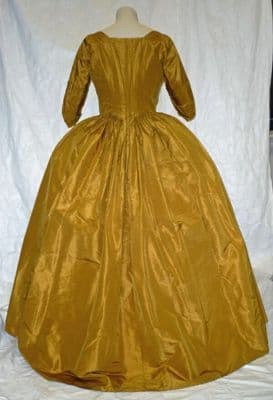
The golden ribbed silk of this sack-back gown and the geometric-patterned kid shoes both speak the language of late 18th-century court refinement, where luxury announced itself through texture rather than ornament. The gown's lustrous vertical ribs catch light the same way the shoes' tiny printed triangles create visual shimmer across their curved surfaces—both using repetitive pattern to generate richness without relying on applied decoration.
58%
Worn with·chemiseWorn with·staysFunction·court-formal
SHAREDsame era · cross-culture · cross-category
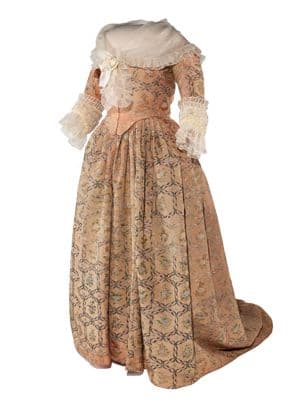
Both pieces inhabit that narrow window when pink was the height of sophistication—before the Revolution made such delicate hues seem frivolous. Martha Washington's coral silk catches light in its woven florals with the same studied refinement as these British court shoes, where tiny geometric patterns create texture across pink kid leather.
58%
Worn with·gartersTechnique·leather-working
SHARED40 years
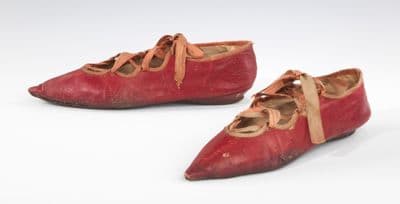
These burgundy latchet shoes from the Rococo period and the pink kid pumps from the Revolutionary era capture the dramatic shift in women's footwear as fashion moved from Georgian excess to neoclassical restraint.
Pull the Thread→
Follow this garment wherever the graph leads