Belle Epoque · 1910s · American
Production
handmade
Material
silk chiffon
Culture
American
Movement
Neoclassical Revival
Influences
Empire waist revival · Directoire neoclassical influence
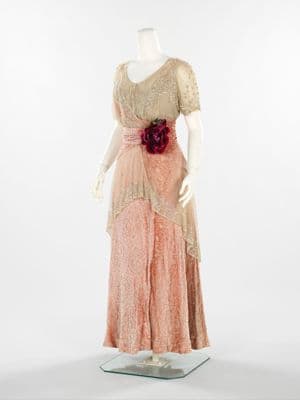
This Belle Époque evening gown features a high empire waistline marked by a burgundy silk flower corsage. The bodice appears to be constructed from cream-colored silk chiffon with short, gathered sleeves that create soft volume at the shoulders. The skirt cascades in multiple graduated tiers of pale pink silk chiffon, each layer creating gentle horizontal lines that emphasize the flowing, columnar silhouette characteristic of pre-war fashion. The tiers appear to be cut on the bias, allowing the lightweight fabric to drape naturally and create subtle movement. The overall construction demonstrates the period's preference for softer, more natural silhouettes that departed from the rigid corseted forms of the Victorian era.


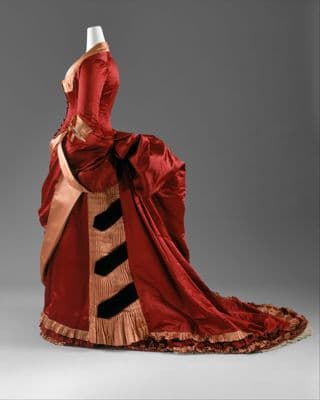
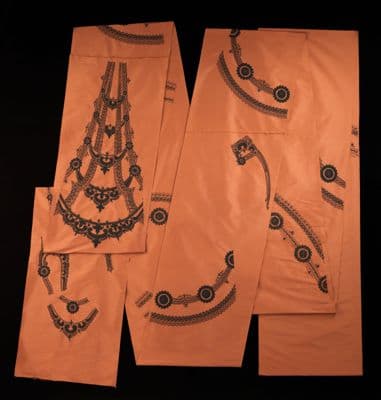
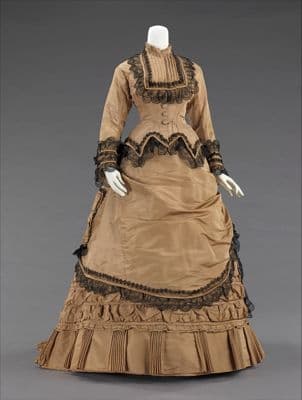
These two garments reveal how the Belle Époque's romantic languor grew directly from the Victorian obsession with ornamental excess. The coral silk pattern pieces map out a bustle dress heavy with black passementerie—those cascading loops and medallions that would have created a rattling symphony of jet beads and silk cord with every step.

Follow this garment wherever the graph leads
The burgundy bustle gown's architectural drama—that sculptural rear projection and knife-sharp pleating—gives way to the Belle Époque dress's softer seductions: cascading chiffon tiers that whisper where the earlier dress proclaimed. Both demand the same rigorous foundation garments, but where the 1870s silhouette carved space with geometric precision, the 1900s version melts downward in romantic pools, trading Victorian engineering for Edwardian poetry.
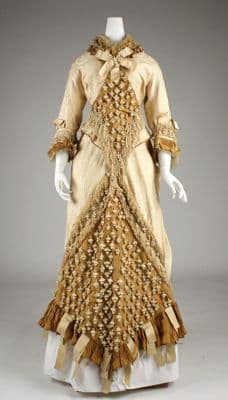
These Belle Époque gowns reveal how the same era's obsession with feminine excess could take radically different forms. The French dress attacks the eye with its aggressive lattice of golden brown trim—a geometric assault that turns the body into architecture—while the American gown whispers its luxury through layers of gossamer chiffon that seem to float independently of each other.
These two garments reveal how the Belle Époque's romantic languor grew directly from the Victorian obsession with ornamental excess. The coral silk pattern pieces map out a bustle dress heavy with black passementerie—those cascading loops and medallions that would have created a rattling symphony of jet beads and silk cord with every step.
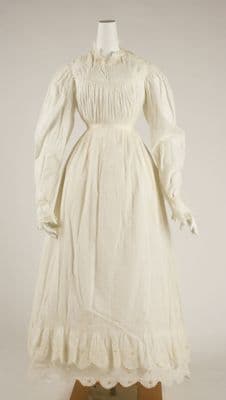
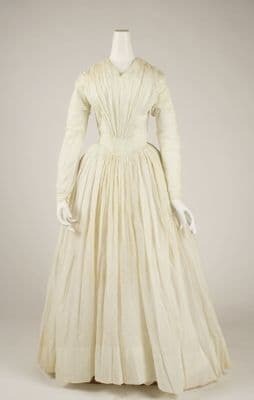
These two gowns speak the same romantic language across nearly a century, both deploying cascading tiers and gossamer fabrics to create that coveted "floating" silhouette. The earlier muslin dress uses pintucks and ruffles to build its ethereal volume, while the Belle Époque gown achieves the same weightless effect through silk chiffon's natural drape and those signature tiered layers that became evening wear's answer to the wedding cake.

These two gowns speak the same romantic language across nearly a century, both deploying cascading tiers and gossamer fabrics to create that coveted "floating" silhouette. The earlier muslin dress uses pintucks and ruffles to build its ethereal volume, while the Belle Époque gown achieves the same weightless effect through silk chiffon's natural drape and those signature tiered layers that became evening wear's answer to the wedding cake.