THE MET
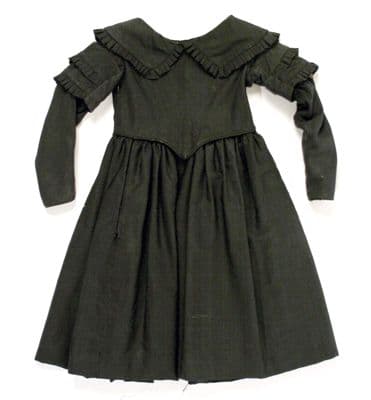
Dark Forest Green Silk Wool Mourning Dress
Victorian Early / Crinoline · 1840s · American
Production
handmade
Material
silk and wool blend
Culture
American
Influences
1840s romantic sleeve treatment · Quaker plain dress tradition
This 1840s mourning dress features a fitted bodice with distinctive layered ruffle trim cascading down the shoulders and upper arms. The dress has long fitted sleeves and a full gathered skirt typical of early Victorian silhouettes. The dark forest green fabric appears to be a silk and wool blend with a matte finish appropriate for mourning attire. Multiple tiers of self-fabric ruffles create dimensional texture across the shoulder line and upper bodice. The dress fastens at the back and would have been worn over a corset and multiple petticoats to achieve the proper bell-shaped silhouette of the 1840s.
dressfit and flareround neckbelow the knee
Connected To
Worn with·chemiseWorn with·corsetFunction·mourning
SHARED40 years · cross-culture · cross-category
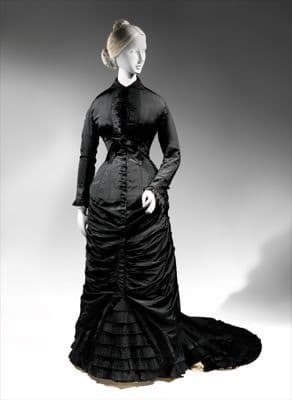
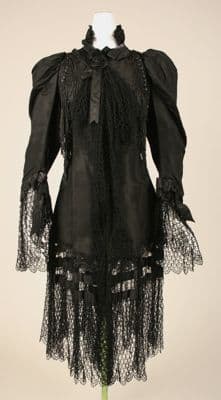
These two garments trace the evolution of Victorian mourning dress from solemn restraint to theatrical excess. The earlier green dress adheres to the austere codes of 1850s mourning—its deep forest tone suggesting half-mourning, with ruffled shoulder details that whisper rather than shout—while the later black coat explodes into full Gothic drama with cascading lace tiers and exaggerated leg-of-mutton sleeves that turn grief into performance.
Echoes Across Time
Victorian Late / Bustle → Victorian Early / Crinoline · 40yr58%
SHARED
These two garments trace the evolution of Victorian mourning dress from solemn restraint to theatrical excess. The earlier green dress adheres to the austere codes of 1850s mourning—its deep forest tone suggesting half-mourning, with ruffled shoulder details that whisper rather than shout—while the later black coat explodes into full Gothic drama with cascading lace tiers and exaggerated leg-of-mutton sleeves that turn grief into performance.
Worn with·chemiseWorn with·corsetFunction·mourning
Pull the Thread→
Follow this garment wherever the graph leads