Edwardian · 1900s-1910s · American
Production
haute couture
Material
silk damask brocade
Culture
American
Influences
S-curve silhouette · Worth-inspired trained skirt
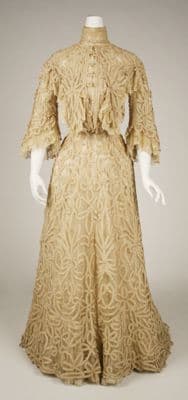
This Edwardian formal dress features a high-necked bodice with three-quarter sleeves ending in dramatic cascading fringe trim. The silk damask brocade displays an intricate woven pattern throughout in tonal champagne and gold. The bodice fits closely to the natural waist before flowing into a trained A-line skirt that pools elegantly on the floor. The fringe detailing on the sleeves creates textural movement and catches light, typical of the period's love for surface embellishment. The overall silhouette reflects the S-curve ideal of the early 1900s, with its emphasis on a defined waist and flowing lower portion. The luxurious fabric and formal construction indicate this was designed for affluent social occasions during the height of the Edwardian era.


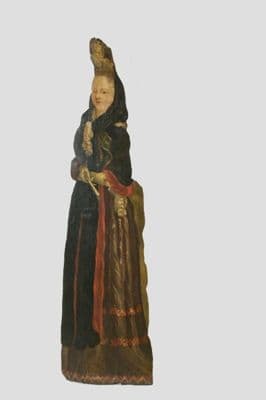
The Edwardian dress's languid silk damask and that Baroque gown's rich green silk are separated by two centuries but united by the same aristocratic impulse: both demand the full armor of understructure—chemise, corset, petticoat—to achieve their intended silhouettes.

Follow this garment wherever the graph leads
The Edwardian dress's languid silk damask and that Baroque gown's rich green silk are separated by two centuries but united by the same aristocratic impulse: both demand the full armor of understructure—chemise, corset, petticoat—to achieve their intended silhouettes.
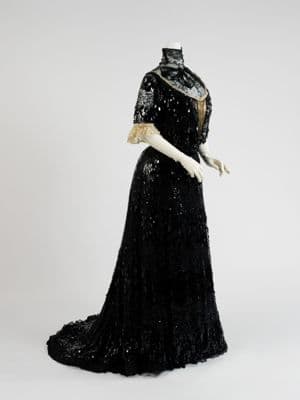
These two gowns reveal how the same aristocratic impulse—to shimmer expensively in candlelight—evolved across the fin de siècle divide. The earlier black sequined dress deploys its sparkle like armor, each paillette catching light in the rigid Victorian manner of conspicuous display, while the champagne damask flows with the looser, more naturalistic drape that would define Edwardian elegance.
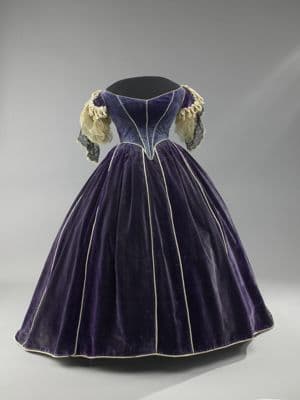
The champagne dress's cascading fringe and the purple velvet's elaborate gold passementerie both speak the same language of American formal wear's obsession with surface animation—one through movement, the other through metallic gleam.
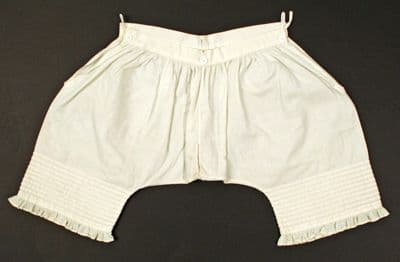
These garments reveal the hidden architecture of Victorian and Edwardian dressing—the plain cotton drawers with their practical drawstring waist and modest knee-length cut would have been the invisible foundation beneath that elaborate champagne silk dress with its cascading damask patterns and fitted bodice.

The champagne dress's cascading fringe and the purple velvet's elaborate gold passementerie both speak the same language of American formal wear's obsession with surface animation—one through movement, the other through metallic gleam.