SMITHSONIAN
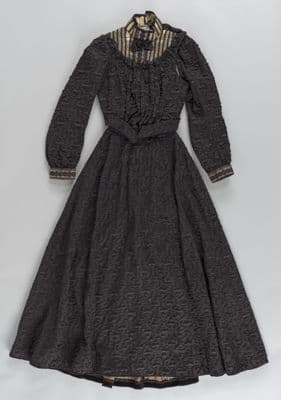
Black Textured Wool Bodice and Skirt with Lace
Victorian Late / Bustle · 1890s · American
Production
handmade
Material
textured wool
Culture
American
Influences
1890s fitted bodice silhouette · Victorian high collar styling
A two-piece black wool dress consisting of a fitted bodice and full skirt characteristic of 1890s silhouettes. The bodice features long fitted sleeves with gathered shoulders and a high neckline with standing collar. The textured wool fabric appears to have a subtle woven or jacquard pattern creating surface interest. Cream-colored striped silk trim accents the collar and cuffs, providing contrast against the dark wool. The skirt extends to floor length with moderate fullness typical of the post-bustle era when skirts began to narrow but retained substantial volume. A matching fabric belt defines the natural waistline. The construction demonstrates typical Victorian tailoring with precise fitting through the torso.
dressfit and flarehigh neckfloor length
Connected To
59%
Worn with·chemiseWorn with·corsetWorn with·petticoat
SHARED35 years · cross-culture
Echoes Across Time
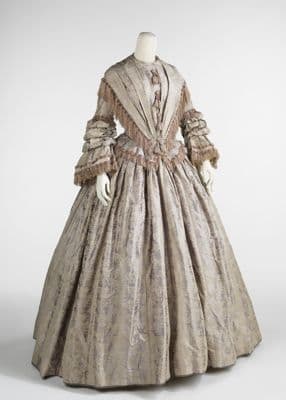
Victorian Early / Crinoline → Victorian Late / Bustle · 35yr59%
SHARED
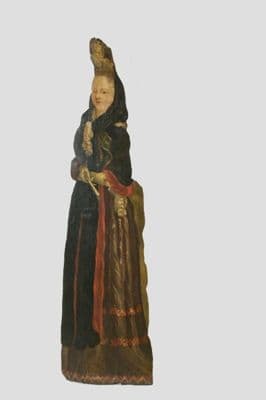
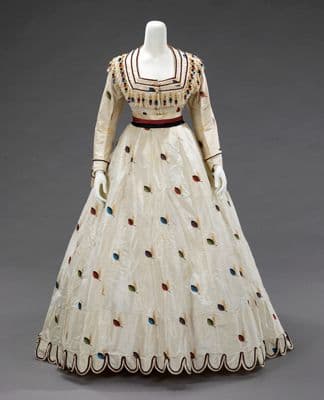
These two dresses trace the Victorian woman's slow liberation from architectural excess. The earlier silk brocade, with its bell-shaped crinoline silhouette and yards of precious fabric, represents the 1850s ideal of conspicuous leisure—a woman so removed from physical labor she could navigate doorways in a dress wider than her arm span.
Worn with·chemiseWorn with·corsetWorn with·petticoat
Pull the Thread→
Follow this garment wherever the graph leads