Empire / Regency · 1810s · French
Production
handmade
Material
wool with silk embroidery
Culture
French
Influences
military uniform styling · Napoleonic court dress
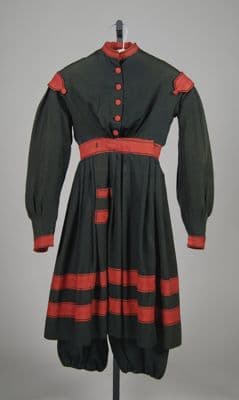
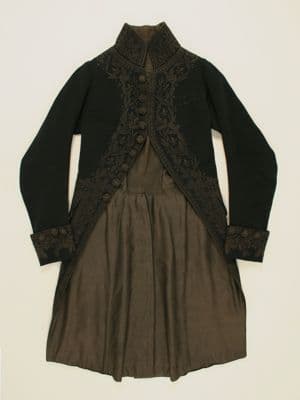
A dark green wool tailcoat jacket featuring elaborate silk embroidery across the front panels and cuffs. The high standing collar and double-breasted front closure with decorative braiding reflect military uniform influence typical of the Empire period. The fitted bodice extends into long tails that would fall below the knee, creating the characteristic silhouette of early 19th-century menswear. Intricate foliate embroidery in matching green silk covers the front edges and sleeve cuffs, demonstrating the period's taste for ornate surface decoration. The structured shoulders and precise tailoring showcase the era's emphasis on masculine elegance and military-inspired civilian dress.
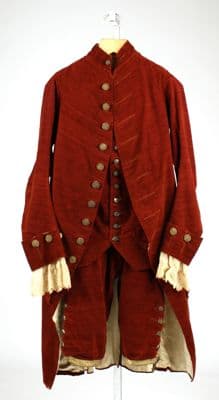
These two formal coats trace the evolution of military swagger into civilian dress across the Napoleonic divide. The earlier burgundy velvet suit channels 18th-century British restraint—its double-breasted front and brass buttons speak the language of naval authority, while the cream silk stockings and knee breeches maintain aristocratic propriety.

These two formal coats trace the evolution of military swagger into civilian dress across the Napoleonic divide. The earlier burgundy velvet suit channels 18th-century British restraint—its double-breasted front and brass buttons speak the language of naval authority, while the cream silk stockings and knee breeches maintain aristocratic propriety.


Follow this garment wherever the graph leads
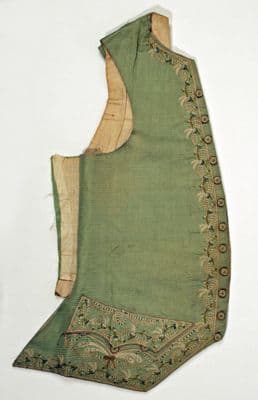
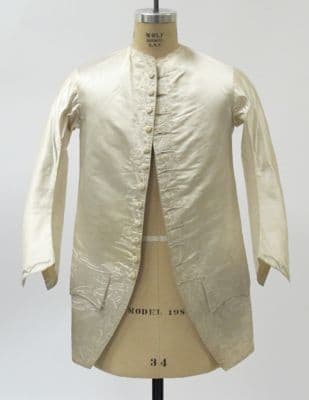
The dark green tailcoat's elaborate silk embroidery and fitted silhouette descend directly from the cream waistcoat's close-cut body and decorative impulse, though fifty years and a revolution separate them. Where the Rococo waistcoat achieves its drama through pure line—that sharp-angled front opening and skin-tight fit—the Empire coat translates the same body-conscious tailoring into military theater, using braided passementerie to trace the torso's contours.
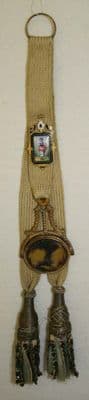
The dark green tailcoat's elaborate silk embroidery and the delicate watch fob both speak the same language of masculine ornament, though separated by decades and degrees of restraint. Where the Rococo fob whispers its decorative intent through gold accents and silk tassels—a gentleman's jewelry meant to catch light as he checks his timepiece—the Empire coat shouts it through dense floral scrollwork that transforms the entire garment into wearable art.
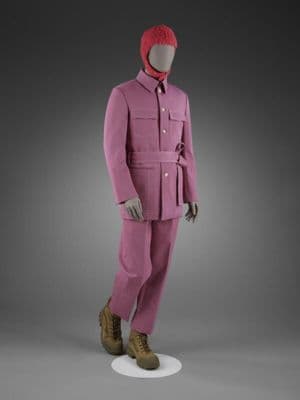
The frogged embroidery cascading down the Empire tailcoat's front and the clean military lines of the contemporary Zhongshan suit reveal how power dressing has traveled from Napoleon's officers to Mao's revolution to today's boardrooms.
The dark green tailcoat's elaborate silk embroidery and fitted silhouette descend directly from the cream waistcoat's close-cut body and decorative impulse, though fifty years and a revolution separate them. Where the Rococo waistcoat achieves its drama through pure line—that sharp-angled front opening and skin-tight fit—the Empire coat translates the same body-conscious tailoring into military theater, using braided passementerie to trace the torso's contours.