1950s · 1950s · French
Production
handmade
Material
printed cotton
Culture
French
Movement
New Look · New Look / Post-War
Influences
Christian Dior New Look silhouette
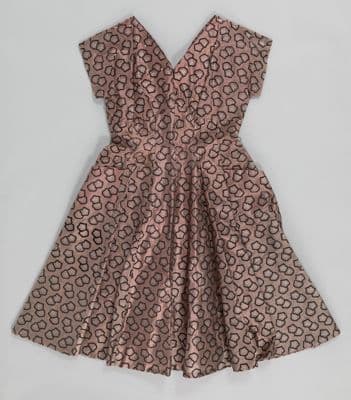
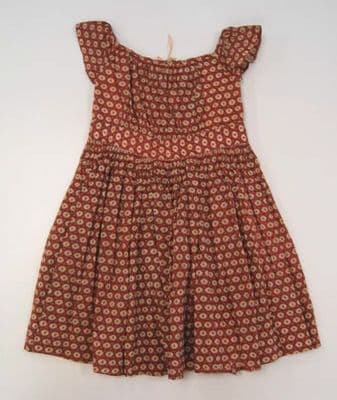
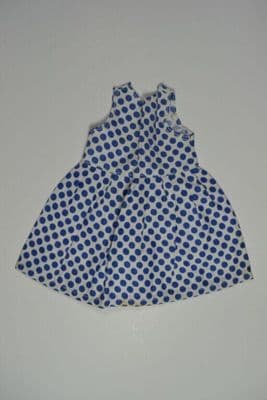
A miniature sleeveless dress featuring a fitted bodice that transitions into a full A-line skirt, characteristic of 1950s New Look silhouettes scaled for doll wear. The garment displays an all-over polka dot pattern in navy blue on white cotton ground, with dots arranged in regular geometric spacing. The bodice appears to have a high round neckline and armholes cut close to the body. The skirt portion flares dramatically from the natural waistline, creating the bell-shaped silhouette popularized by Christian Dior's New Look. The lightweight cotton fabric allows the skirt to stand away from the body while maintaining the crisp, structured appearance typical of post-war fashion optimism and domestic femininity.


These two dresses are separated by six decades but united by the enduring power of Dior's New Look silhouette—that cinched waist blooming into a full skirt that made women look like flowers after the austere war years. The 1950s French dress with its precise polka dots and crisp A-line speaks the original language of post-war femininity, while the 2000s coral piece translates that same vocabulary into softer, more casual terms with its floral print and relaxed fit-and-flare proportions.

Follow this garment wherever the graph leads
These two 1950s dresses reveal how Dior's New Look became a universal language, speaking fluent French sophistication in one breath and American optimism in the next. The mauve organza dress whispers its geometry through delicate florals and a deeper V-neck, while the French cotton version shouts the same fitted-bodice-to-full-skirt formula in bold polka dots and a more demure neckline.
These two dresses are separated by six decades but united by the enduring power of Dior's New Look silhouette—that cinched waist blooming into a full skirt that made women look like flowers after the austere war years. The 1950s French dress with its precise polka dots and crisp A-line speaks the original language of post-war femininity, while the 2000s coral piece translates that same vocabulary into softer, more casual terms with its floral print and relaxed fit-and-flare proportions.
The cream tunic's soft A-line and nipped waist echo the DNA of Dior's New Look, but stripped of its formality—what was once revolutionary structure for postwar optimism has become easy daywear pragmatism. The polka-dot dress, closer to the 1947 source, still carries that original defiant femininity with its full skirt and fitted bodice, while the modern piece translates the same proportions into something you'd grab for errands.
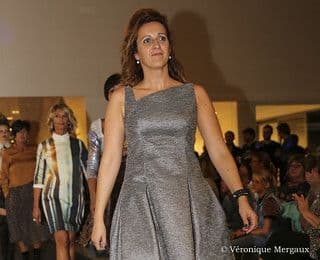
Both dresses speak the same language of feminine architecture that Dior codified in 1947: the fitted bodice flowing into a full, sculptural skirt that makes the waist disappear into pure geometry. The metallic brocade gown translates this mid-century formula into contemporary glamour with its one-shoulder drape and liquid shine, while the polka-dotted cotton dress delivers the original promise in its purest form—that sweet spot where structure meets swing.

The cream tunic's soft A-line and nipped waist echo the DNA of Dior's New Look, but stripped of its formality—what was once revolutionary structure for postwar optimism has become easy daywear pragmatism. The polka-dot dress, closer to the 1947 source, still carries that original defiant femininity with its full skirt and fitted bodice, while the modern piece translates the same proportions into something you'd grab for errands.