1950s · 1950s · American
Production
ready-to-wear
Material
synthetic organza
Culture
American
Movement
New Look · New Look / Post-War
Influences
Christian Dior New Look silhouette
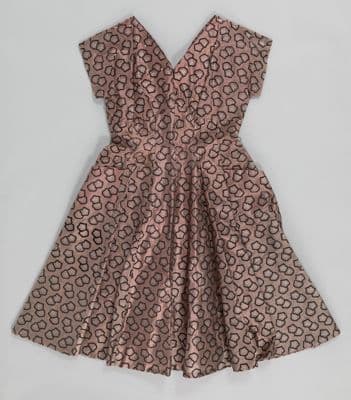
A sleeveless dress featuring a fitted V-neck bodice that transitions into a full circle skirt typical of 1950s silhouettes. The synthetic organza fabric displays an all-over geometric pattern of interlocking circles in burgundy on a mauve-pink ground. The bodice appears to have princess seaming for a close fit through the torso, while the skirt extends to mid-calf length with considerable fullness that would require petticoats for proper shape. The V-neckline creates clean shoulder lines, and the sleeveless construction suggests warm-weather wear. The geometric motif reflects the era's embrace of modern, abstract patterns over traditional florals.
Follow this garment wherever the graph leads
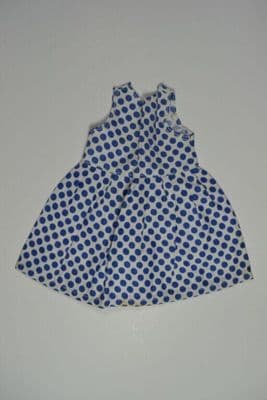
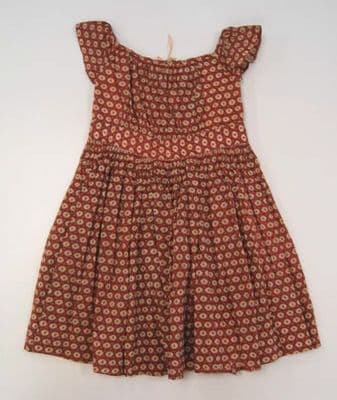
These two 1950s dresses reveal how Dior's New Look became a universal language, speaking fluent French sophistication in one breath and American optimism in the next. The mauve organza dress whispers its geometry through delicate florals and a deeper V-neck, while the French cotton version shouts the same fitted-bodice-to-full-skirt formula in bold polka dots and a more demure neckline.
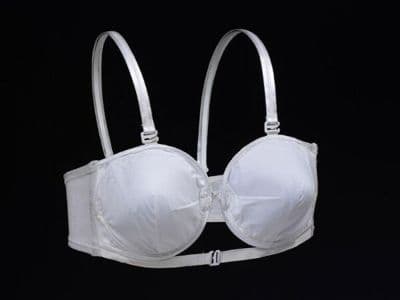
The white molded bra and the mauve organza dress are engineering partners in Dior's New Look revolution, both designed to sculpt the same hourglass ideal from opposite directions. The bra's conical cups and rigid underwire create the foundation for the dress's nipped waist and full circle skirt — you can practically see how that structured bustline would fill out the dress's fitted bodice.
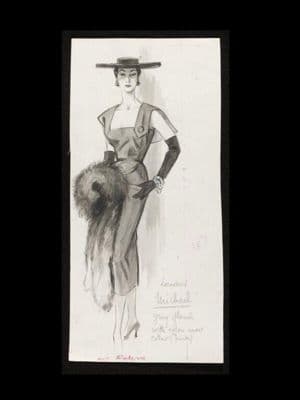
The 1950s sketch captures the New Look's essential geometry—that nipped waist blooming into a full skirt that demands a petticoat's architectural support—while the mauve organza dress translates Dior's Parisian manifesto into American ready-to-wear reality. What bridges the Atlantic between them is that shared obsession with the female silhouette as hourglass, where fabric becomes sculpture and the waist becomes a fulcrum for yards of material.
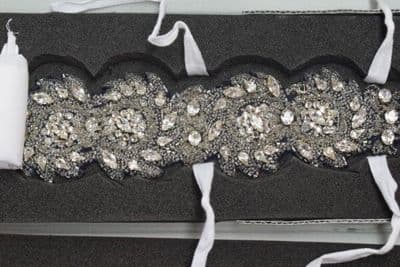
The crystalline constellation of beads and diamantes on this French evening belt speaks the same decorative language as the delicate floral motifs scattered across the American organza dress — both are expressions of 1950s femininity's obsession with surface ornament and controlled abundance.