V&A
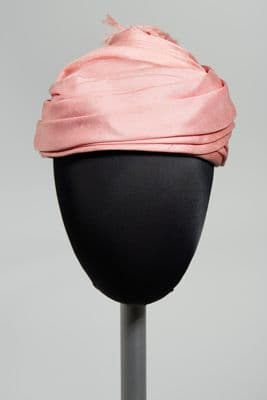
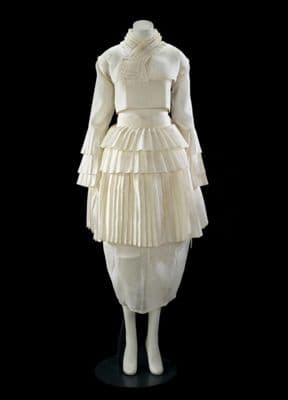
Ivory Silk Korean Sseugaechima Head Covering
2020s · 2020s · Korean
Production
handmade
Material
silk
Culture
Korean
Movement
Korean Wave cultural revival · Dopamine Dressing
Influences
traditional Korean hanbok · jeogori fitted jacket · chima full skirt
A contemporary interpretation of traditional Korean hanbok featuring a high-necked fitted bodice with long sleeves and a multi-tiered skirt that falls to mid-calf length. The garment is constructed entirely in ivory silk with subtle tonal variations. The bodice appears to have traditional Korean closure elements at the front, while the skirt displays three distinct tiers of varying widths, creating dimensional volume. The sleeves are fitted through the arm with slight gathering at the wrist. The silhouette maintains the essential proportions of hanbok - the fitted jeogori-style top contrasted with the full chima-style skirt - while adapting the length and construction techniques for contemporary wear.
headband/head covering/hair accessory
Connected To
Influences·traditional Korean hanbokTechnique·pleatingFunction·religious-ceremonial
SHARED40 years · cross-category
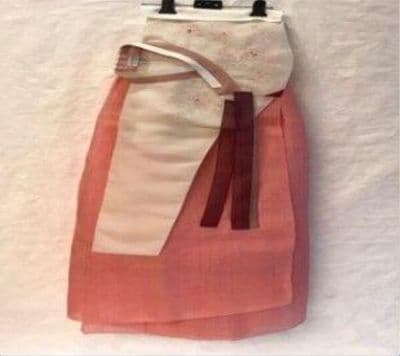
The coral hanbok's knife-sharp pleats cascade with the same mathematical precision as the ivory head covering's accordion folds, both garments speaking the ancient Korean language of structured silk that transforms flat fabric into sculptural volume. Forty years separate them, but they share hanbok's foundational grammar: that distinctive way of creating movement through geometric pleating that makes the body both more and less present.
Influences·traditional Korean hanbokFunction·religious-ceremonial
SHARED30 years · cross-category
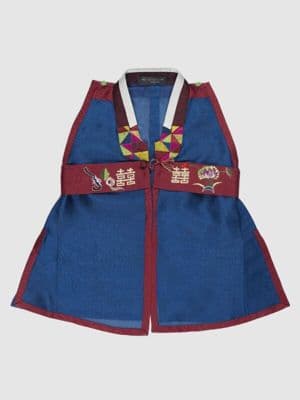
The royal blue durumagi's geometric precision—those clean lines, the controlled flare from chest to hem, the deliberate contrast piping—finds its echo in the contemporary sseugaechima's architectural pleating and layered construction.
Movement·Dopamine Dressing
VISUAL ECHOsame era · cross-culture · cross-category
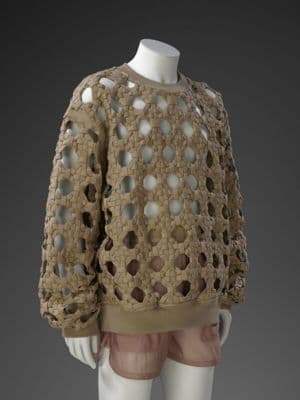
Both garments speak the same language of deliberate volume and rhythmic repetition, just in different dialects. The honeycomb sweater's oversized mesh creates an all-over pattern of voids and solids that echoes the Korean head covering's cascading tiers of pleated silk, each fold catching light and shadow in measured intervals.
Text
Technique·pleatingFunction·religious-ceremonial
SHARED120 years · cross-culture
Text47%
Echoes Across Time
Korean Traditional → 2020s · 40yr69%
SHARED
The coral hanbok's knife-sharp pleats cascade with the same mathematical precision as the ivory head covering's accordion folds, both garments speaking the ancient Korean language of structured silk that transforms flat fabric into sculptural volume. Forty years separate them, but they share hanbok's foundational grammar: that distinctive way of creating movement through geometric pleating that makes the body both more and less present.
Influences·traditional Korean hanbokTechnique·pleatingFunction·religious-ceremonial
Pull the Thread→
Follow this garment wherever the graph leads