V&A
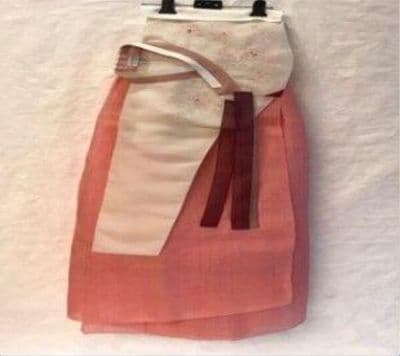
Coral Red Silk Hanbok Ensemble with White Jeogori
Korean Traditional · 1980s · Korean
Production
handmade
Material
silk
Culture
Korean
Influences
traditional Korean hanbok · 1980s power suiting structure
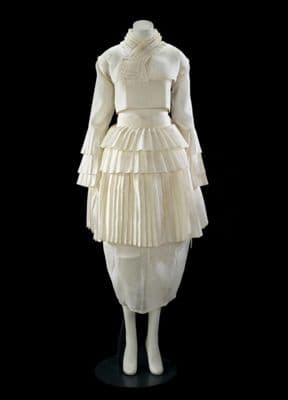
This Korean hanbok ensemble features a structured white jeogori (jacket) with a high neckline and fitted bodice that extends into a short peplum. The coral-red chima (skirt) displays the characteristic full, bell-shaped silhouette of traditional Korean dress, gathered at a high waistline just below the bust. White ribbon ties at the jacket front provide closure in the traditional manner. The silk fabric appears to have a subtle sheen, and the garment maintains the classic hanbok proportions with the short jacket contrasting against the voluminous skirt. The construction shows clean lines and precise tailoring that bridges traditional Korean dress codes with 1980s formal wear sensibilities.
dressa-linemidi
Connected To
Influences·traditional Korean hanbokTechnique·pleatingFunction·religious-ceremonial
SHARED40 years · cross-category
The coral hanbok's knife-sharp pleats cascade with the same mathematical precision as the ivory head covering's accordion folds, both garments speaking the ancient Korean language of structured silk that transforms flat fabric into sculptural volume. Forty years separate them, but they share hanbok's foundational grammar: that distinctive way of creating movement through geometric pleating that makes the body both more and less present.
57%
Worn with·undergarmentsFunction·religious-ceremonial
LINEAGEsame era · cross-category→ directed
Lineage: “Korean hanbok jeogori”
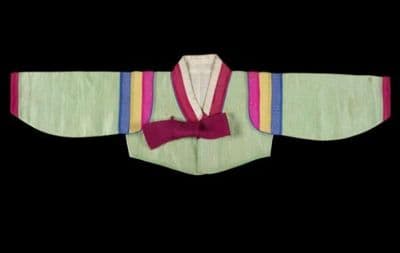
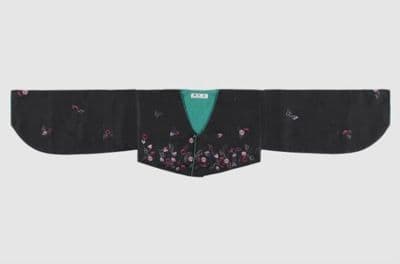
These two hanbok pieces reveal how Korean traditional dress balances restraint with strategic bursts of color. The coral ensemble uses its saturated hue as the dominant statement, while the black jeogori deploys teal and pink as precise punctuation marks against the dark ground—both approaches rooted in the hanbok's philosophy that color should be deliberate, never accidental.
Worn with·undergarmentsTechnique·pleating
SHARED30 years · cross-culture
Text54%
Worn with·undergarmentsTechnique·pleating
SHAREDsame era · cross-culture · cross-category
Text58%
Echoes Across Time
Korean Traditional → 2020s · 40yr69%
SHARED
The coral hanbok's knife-sharp pleats cascade with the same mathematical precision as the ivory head covering's accordion folds, both garments speaking the ancient Korean language of structured silk that transforms flat fabric into sculptural volume. Forty years separate them, but they share hanbok's foundational grammar: that distinctive way of creating movement through geometric pleating that makes the body both more and less present.
Influences·traditional Korean hanbokTechnique·pleatingFunction·religious-ceremonial
Pull the Thread→
Follow this garment wherever the graph leads