1970s · 1970s · British
Designer
Kaffe Fassett
Production
handmade
Material
wool
Culture
British
Movement
Craft Revival · Hippie / Counterculture
Influences
Fair Isle knitting tradition · 1970s craft revival movement
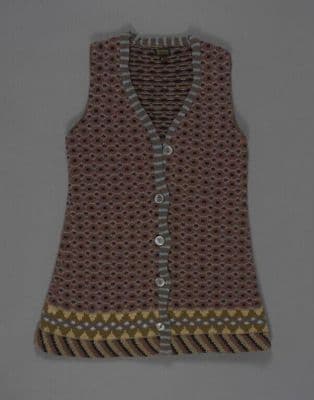
A sleeveless knitted wool waistcoat featuring an intricate geometric pattern in burgundy, cream, yellow, and brown. The garment displays a complex Fair Isle-style colorwork with repeating diamond and chevron motifs across the body, transitioning to a distinctive zigzag border pattern at the hem. The V-neck opening is finished with a ribbed edge in striped pattern, and the front closure features five buttons running down the center. The construction demonstrates sophisticated color knitting techniques typical of 1970s craft revival, with multiple colors carried throughout each row to create the dense geometric patterning. The fitted silhouette and button-front design reflects the era's interest in handcrafted, artistic clothing that combined traditional techniques with bold contemporary color palettes.


These two pieces reveal how Fair Isle's geometric DNA migrated from Highland estates to urban streets across four decades. The 1970s waistcoat speaks pure tradition — that burgundy and cream diamond motif running down the button band, finished with the telltale zigzag border that screams authentic Scottish knitting heritage.


Follow this garment wherever the graph leads
Lineage: “1970s craft revival movement”
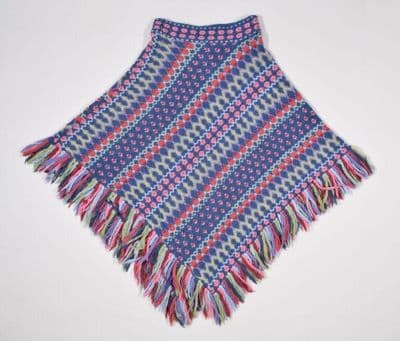
These two pieces capture Kaffe Fassett at different points in his obsession with Fair Isle geometry—the poncho reveling in the full riot of traditional Shetland patterning with its cascading zigzags and rainbow fringe, while the waistcoat distills that same DNA into something more restrained, almost architectural.
These two pieces trace the global migration of Fair Isle's geometric vocabulary, but with telling cultural translations. The 1970s British waistcoat stays true to the tradition's earthy palette and vest format—burgundy, cream, and yellow in tidy horizontal bands that speak to countryside practicality.
These two pieces reveal how Fair Isle's geometric DNA migrated from Highland estates to urban streets across four decades. The 1970s waistcoat speaks pure tradition — that burgundy and cream diamond motif running down the button band, finished with the telltale zigzag border that screams authentic Scottish knitting heritage.
Lineage: “traditional rag rug craft”
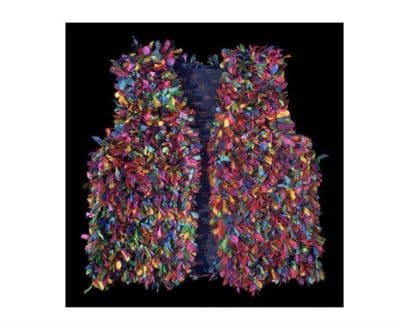
The burgundy waistcoat's tidy geometric knit—those precise diamond motifs marching down the front like a Fair Isle sampler—represents the craft revival's scholarly phase, when traditional techniques were preserved with museum-worthy precision. Two decades later, the explosion of multicolored fabric strips in the second vest shows what happens when that same reverence for handwork gets filtered through rave culture and postmodern irreverence.
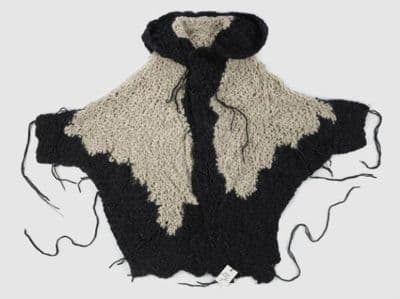
The 1970s waistcoat's tidy geometric pattern and buttoned precision feels like the grandmother of today's chunky, deliberately imperfect hand-knits — both celebrate the visible stitch as ornament, but fifty years apart. Where the vintage piece uses Fair Isle discipline to create neat diamonds and borders, the contemporary hooded cardigan abandons all that restraint for loose, uneven colorblocking that looks like it might unravel tomorrow.