SMITHSONIAN
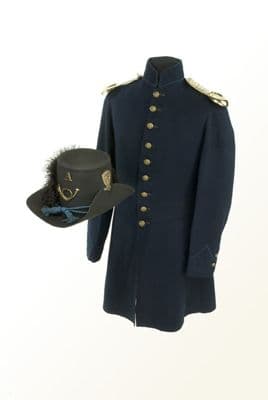
Dark Navy Blue Wool Infantry Frock Coat
Victorian Early / Crinoline · 1860s · American
Production
mass-produced
Material
wool broadcloth
Culture
American
Influences
Civil War military regulations · European military tailoring traditions
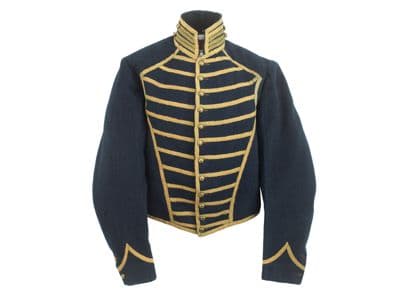
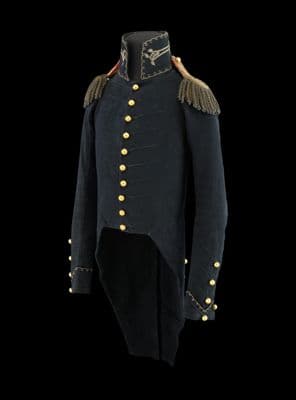
A dark navy blue military frock coat displaying classic Civil War era infantry uniform construction. The coat features a double-breasted front with two rows of brass military buttons, standing collar with gold braided trim, and structured shoulder epaulettes. The wool broadcloth fabric appears heavy and durable, typical of military issue garments. The coat extends to mid-thigh length with a fitted waist and straight skirt. Accompanying the coat is a black felt military hat with decorative plume and brass insignia, known as a Hardee hat. The tailoring shows precise military specifications with reinforced seams and functional button placement for field use.
coatstraighthigh neckknee length
Connected To
Worn with·military capWorn with·military shirtFunction·military-uniform
SHARED120 years
Echoes Across Time
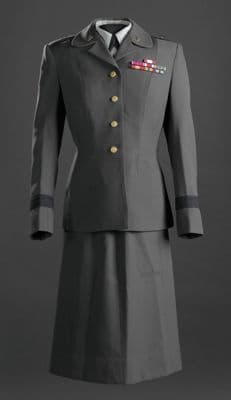
Wartime / Utility Fashion → Victorian Early / Crinoline · 120yr71%
SHARED
These two military jackets reveal how American uniform design has oscillated between formality and function across more than a century. The Civil War-era frock coat with its double row of brass buttons and ceremonial length speaks to an age when military dress borrowed heavily from civilian formalwear, while the World War II-era service jacket—cropped, streamlined, with practical patch pockets and ribbon bars—strips away Victorian pomp for wartime efficiency.
Worn with·military capWorn with·military shirtFunction·military-uniform
Pull the Thread→
Follow this garment wherever the graph leads