SMITHSONIAN
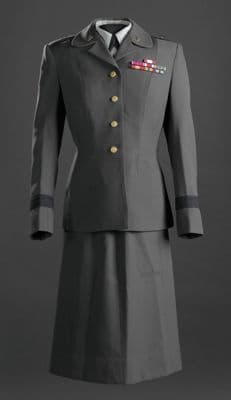
Olive Green Polyester Military Service Uniform Jacket
Wartime / Utility Fashion · 1980s · American
Production
ready-to-wear
Material
polyester gabardine
Culture
American
Influences
military dress uniform tradition · 1980s power suit silhouette
A formal US Army service uniform consisting of a fitted jacket and A-line skirt in olive green polyester gabardine. The jacket features a structured silhouette with peaked lapels, four gold military buttons down the front, and fitted sleeves with decorative cuffs. Military ribbons and insignia are positioned above the left breast pocket, displaying service decorations in red and other colors. The skirt falls to knee length with a clean, straight hemline. The uniform demonstrates the precise tailoring and authoritative silhouette characteristic of military dress uniforms, designed to project competence and command presence during the era when women were achieving higher ranks in the armed forces.
jacketstraighthip length
Connected To
Worn with·military capWorn with·military shirtFunction·military-uniform
SHARED120 years
Echoes Across Time
Wartime / Utility Fashion → Victorian Early / Crinoline · 120yr71%
SHARED
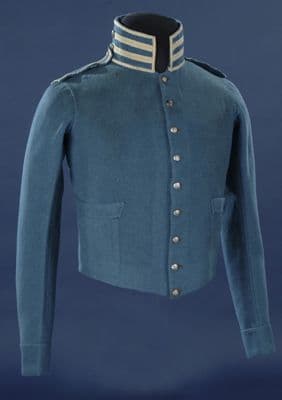
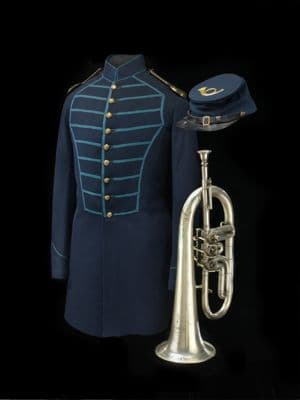
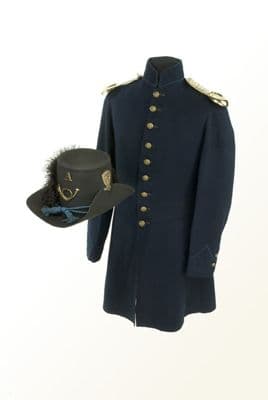
These two military jackets reveal how American uniform design has oscillated between formality and function across more than a century. The Civil War-era frock coat with its double row of brass buttons and ceremonial length speaks to an age when military dress borrowed heavily from civilian formalwear, while the World War II-era service jacket—cropped, streamlined, with practical patch pockets and ribbon bars—strips away Victorian pomp for wartime efficiency.
Worn with·military capWorn with·military shirtFunction·military-uniform
Pull the Thread→
Follow this garment wherever the graph leads