Romantic · 1840s · American
Production
handmade
Material
wool broadcloth
Culture
American
Influences
European military dress traditions
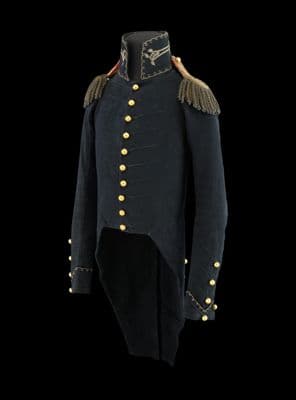
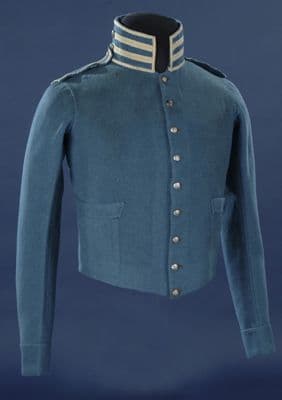
A blue-gray wool broadcloth military coat featuring a high standing collar with gold braid trim and black velvet facing. The coat displays a double-breasted front closure with two parallel rows of brass military buttons extending from chest to waist. The silhouette is fitted through the torso with a cropped length ending at the natural waist. Long sleeves extend to the wrist with plain cuffs. Two patch pockets are positioned at hip level. The construction demonstrates typical mid-19th century American military tailoring with precise seaming and structured shoulders that create a formal, authoritative appearance befitting infantry service during the antebellum period.


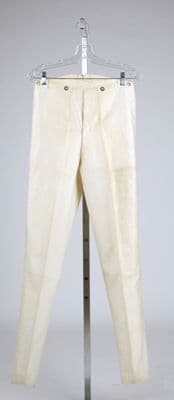
That blue-gray wool coat with its regimental collar stripes and brass button march down the front speaks the same military language as those high-waisted cream trousers with their side-seam piping, even across six decades of American uniform evolution. The coat's formal stance—cropped at the waist, shoulders squared for parade ground precision—finds its echo in the trousers' knife-sharp creases and that telltale military rise that hits well above the natural waist.

Follow this garment wherever the graph leads
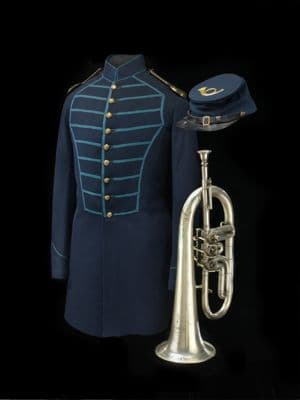
These two American military coats trace the evolution from Napoleonic grandeur to Civil War practicality, yet both cling to the same European DNA of power dressing. Jackson's coat swaggers with those commanding epaulets and the dramatic asymmetrical button closure that screams Empire-era authority, while the later infantry coat has shed the shoulder theater but doubles down on that obsessive military button march up the chest—both using brass as currency for respect.
That blue-gray wool coat with its regimental collar stripes and brass button march down the front speaks the same military language as those high-waisted cream trousers with their side-seam piping, even across six decades of American uniform evolution. The coat's formal stance—cropped at the waist, shoulders squared for parade ground precision—finds its echo in the trousers' knife-sharp creases and that telltale military rise that hits well above the natural waist.
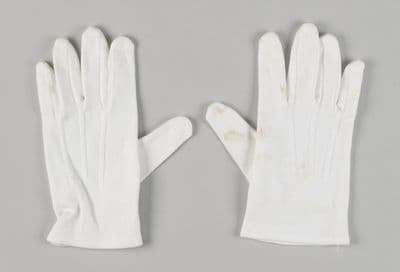
That blue-gray wool coat with its precise row of buttons and gold collar stripes carries the same DNA as those crisp white cotton gloves—both artifacts of military dress codes that transform civilian bodies into symbols of institutional power. The coat's tailored severity, with its stand-up collar and regimental detailing, demands the same meticulous attention to protocol as those gloves, which exist solely to present spotless, regulation hands during ceremonies and inspections.
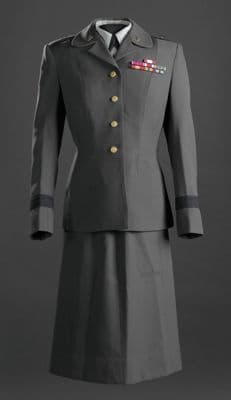
The blue-gray wool coat with its brass buttons marching up the front and gold-striped collar speaks the same visual language as the olive service jacket below it, but across a century and a half that transformed both war and women's place in it.

That blue-gray wool coat with its precise row of buttons and gold collar stripes carries the same DNA as those crisp white cotton gloves—both artifacts of military dress codes that transform civilian bodies into symbols of institutional power. The coat's tailored severity, with its stand-up collar and regimental detailing, demands the same meticulous attention to protocol as those gloves, which exist solely to present spotless, regulation hands during ceremonies and inspections.