V&A
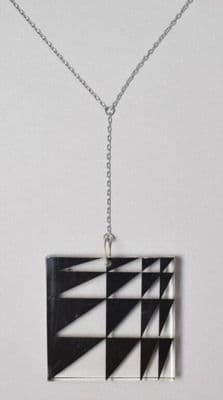
Black White Geometric Screen-Printed Acrylic Pendant Necklace
1960s · 1960s · British
Production
artisan-craft
Material
screen-printed acrylic
Culture
British
Movement
Op Art · Space Age Design · Space Age
Influences
Op Art movement · Bauhaus geometric principles
A striking modernist pendant necklace featuring a square acrylic panel divided into a grid of triangular segments. The geometric composition alternates between black and white triangular forms, creating an optical illusion effect typical of Op Art movement. The pendant is suspended from a fine silver-toned chain via a delicate connecting chain. The acrylic panel appears to be screen-printed with precise geometric divisions, demonstrating the era's embrace of industrial materials and production methods. The mathematical precision of the triangular grid and stark monochromatic palette reflects the Space Age fascination with technology, minimalism, and perceptual experimentation in wearable art.
Connected To
77%
Influences·Op Art movementMovement·Op ArtMovement·Space Age
SHAREDsame era · cross-culture · cross-category
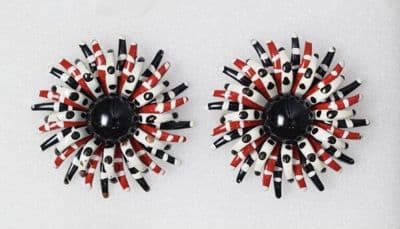
Both pieces pulse with the same Op Art heartbeat that made the 1960s dizzy—the necklace's sharp black-and-white triangular grid creates the same retinal buzz as the earrings' radiating spokes of red, black, and white enamel. The pendant plays it cooler with geometric restraint, while the earrings explode into starburst exuberance, but they're both chasing that same visual high: making your eyes work overtime.
Text69%
Entity67%
77%
Influences·Op Art movementMovement·Op ArtMovement·Space Age
SHAREDsame era · cross-culture · cross-category
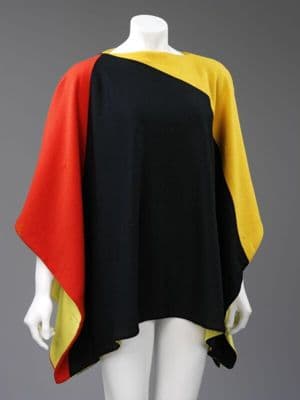
The brutal geometry of that pendant—its black and white triangles creating optical vertigo in miniature—shares DNA with the poncho's bold color blocking, both born from the 1960s obsession with making art you could wear. Where the necklace distills Op Art into a hypnotic grid that seems to pulse against the chest, the poncho explodes those same graphic principles across the body in primary colors that would make Mondrian weep.
75%
Influences·Op Art movementMovement·Op ArtTechnique·screen-printing
SHAREDsame era · cross-culture · cross-category
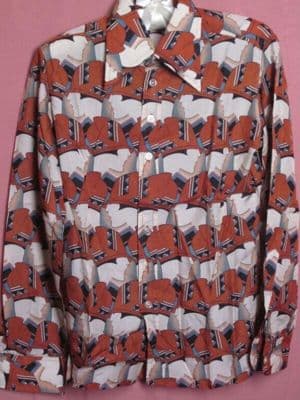
These pieces catch the same optical fever that swept through the late '50s and early '60s, when artists like Bridget Riley were making gallery-goers dizzy with black-and-white geometric patterns. The shirt's tessellated cubes in rust and cream create that signature op-art shimmer across the torso, while the pendant distills the same visual trick into a perfect square of alternating triangular planes.
66%
Influences·Bauhaus geometric principles
SHARED40 years · cross-culture · cross-category
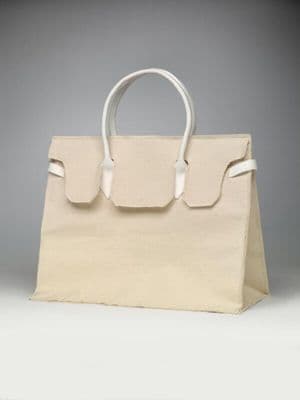
Both pieces speak the same geometric language, but with decades of translation between them. The 1960s pendant's sharp black-and-white triangular grid reads like a miniature Bauhaus manifesto worn at the throat, while the '90s tote translates that same architectural severity into the soft geometry of its boxy silhouette and clean-lined construction.
Text
Pull the Thread→
Follow this garment wherever the graph leads