V&A
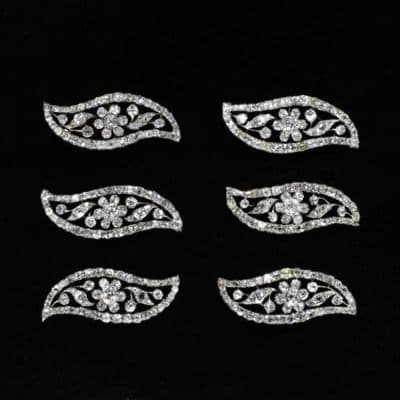
Silver Diamond Shuttle-Shaped Dress Ornament
Rococo · 1760s · Russian
Designer
Leopold Pfisterer
Production
artisan-craft
Material
silver with brilliant-cut diamonds
Culture
Russian
Influences
French court jewelry traditions
Six matching shuttle-shaped dress ornaments crafted from silver and set with brilliant-cut diamonds in an elaborate floral pattern. Each piece features a curved, elongated oval form with pointed ends, containing intricate openwork silver settings that create delicate botanical motifs with central flower forms surrounded by smaller diamond accents. The silver framework displays the refined metalwork characteristic of 18th-century court jewelers, with precise geometric borders of small diamonds outlining each ornament. These pieces would have been sewn onto silk court gowns as part of a larger set, creating glittering surface decoration that caught candlelight in formal palace settings.
Connected To
Worn with·stomacherFunction·court-formal
SHARED40 years · cross-culture
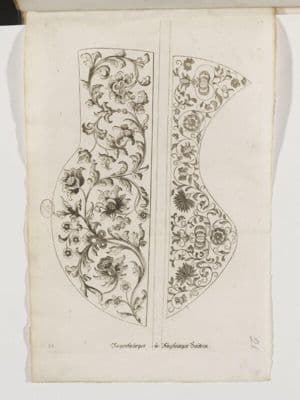
These diamond-crusted shuttles and the engraved pattern share the Rococo's obsession with nature tamed into perfect symmetry—each leaf curl and flower head locked into place like clockwork. The Russian ornaments, meant to glitter down a court stomacher, translate the German engraver's botanical fantasies into three-dimensional sparkle, proving that eighteenth-century luxury was really about making nature more nature-like than nature itself.
Text69%
Image60%
Entity28%
Worn with·stomacherFunction·court-formal
SHARED10 years · cross-culture · cross-category
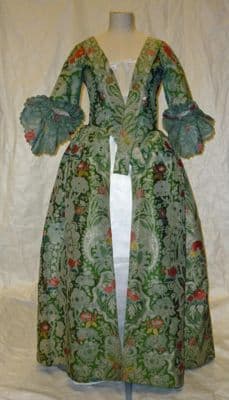
That sumptuous green robe with its cascading floral brocade and those glittering diamond shuttles both speak the same rococo language of nature rendered precious—one through silk weavers translating botanical forms into thread, the other through jewelers crystallizing leaf motifs in brilliant-cut stones.
Worn with·stomacherFunction·court-formal
SHARED10 years · cross-culture · cross-category
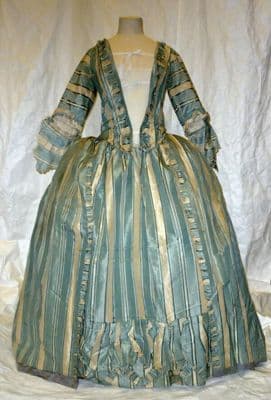
These diamond shuttle ornaments would have glittered against the very kind of silk-striped stomacher that anchors this English sack-back gown — both artifacts of the Rococo's obsession with surface play and optical tricks. The ornaments' paisley-like curves echo the gown's serpentine trim that snakes along every seam, while their brilliant-cut diamonds would have caught light just as the silk taffeta's alternating matte and lustrous stripes create their own shimmer.
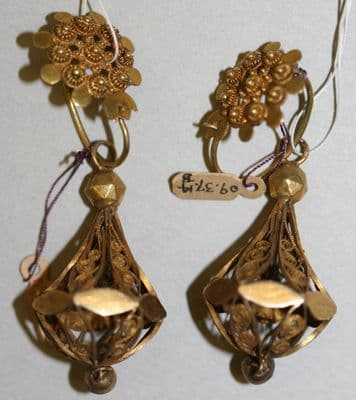
Technique·metalworkFunction·court-formal
SHARED120 years · cross-culture
Text63%
Pull the Thread→
Follow this garment wherever the graph leads