THE MET
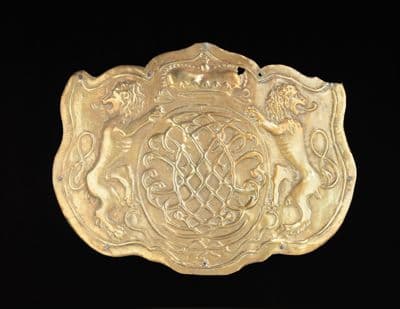
Brass Austrian Imperial Military Belt Plate
Victorian Early / Crinoline · 1840s · Austrian
Production
artisan-craft
Material
brass
Culture
Austrian
Influences
Habsburg imperial heraldry
A decorative brass military belt plate featuring elaborate embossed relief work in the Austrian imperial style. The central motif displays an intricately woven lattice pattern surrounded by heraldic elements including what appears to be a crown at the top and flanking decorative scrollwork. The plate has a distinctive scalloped edge with curved indentations, typical of mid-19th century military regalia. The brass surface shows fine detail work with raised elements creating depth and shadow, indicating skilled metalworking craftsmanship. The overall composition suggests this served as a ceremonial or dress uniform component for Austrian military forces during the Habsburg period.
belt
Connected To
Technique·metalworkFunction·military-uniformMotif·heraldic
SHARED40 years · cross-culture · cross-category
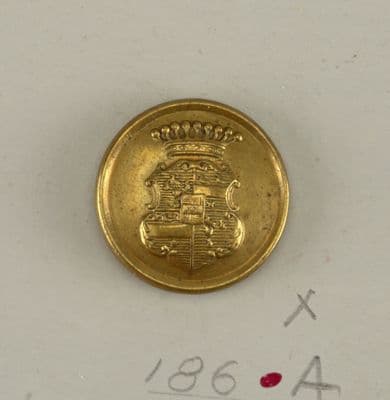
These two pieces of military brass reveal how empire dresses itself in metal. The Austrian belt plate's elaborate baroque swirls and heraldic beasts sprawl across its scalloped surface like a miniature throne room, while the French button compresses similar imperial ambitions into a tight, coin-like disc crowned with a simple crest.
Text75%
Image71%
Technique·metalworkFunction·military-uniformMotif·heraldic
SHARED40 years · cross-culture · cross-category
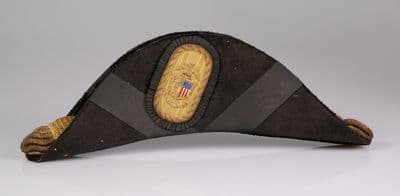
This Austrian belt plate's baroque swirl of imperial eagles and heraldic flourishes speaks the same ornamental language as the American bicorne's gilded insignia, both pieces insisting that military authority requires theatrical display. The bicorne's oval medallion echoes the belt plate's central cartouche—forty years later, American officers were still borrowing Europe's vocabulary of embossed prestige, just scaled down from waist-spanning brass bombast to a discrete forehead whisper.
Function·military-uniformMotif·heraldic
SHARED10 years · cross-culture · cross-category
Text52%
Technique·metalworkFunction·military-uniform
SHARED440 years · cross-culture · cross-category
Text43%
Echoes Across Time
Victorian Early / Crinoline → Empire / Regency · 40yr57%
SHARED
These two pieces of military brass reveal how empire dresses itself in metal. The Austrian belt plate's elaborate baroque swirls and heraldic beasts sprawl across its scalloped surface like a miniature throne room, while the French button compresses similar imperial ambitions into a tight, coin-like disc crowned with a simple crest.
Technique·metalworkFunction·military-uniformMotif·heraldic
Pull the Thread→
Follow this garment wherever the graph leads