THE MET
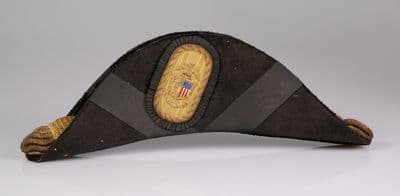
Black Fur Felt Military Bicorne Hat
Victorian Late / Bustle · 1880s · American
Production
handmade
Material
fur felt
Culture
American
Influences
Napoleonic bicorne tradition · American military heraldry
A black fur felt bicorne hat with distinctive crescent shape formed by upturned front and back brims. The hat features gold braided trim along the edges and a central oval cockade with patriotic American shield motif in red, white, and blue. The cockade displays vertical stripes suggesting the American flag. Gold tasseled cords hang from either side of the hat. The construction shows typical late 19th century military millinery techniques with stiffened felt body and applied decorative elements. The bicorne style, while originating in the 18th century, remained in use for American military dress uniforms throughout the Victorian period.
hat
Connected To
Worn with·military dress uniformTechnique·metalworkFunction·military-uniform
SHARED70 years · cross-culture · cross-category
These pieces speak the same language of military pomp across seven decades and an ocean. The golden epaulets' cascading bullion fringe and the bicorne's elaborate gilt tassels both deploy that distinctly 19th-century logic where more ornament equals more authority—the kind of decorative excess that announced rank from across a parade ground.
Text66%
Image68%
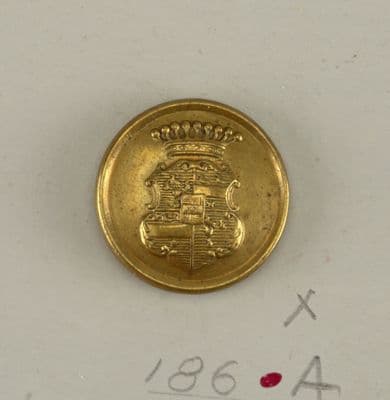
Technique·metalworkFunction·military-uniformMotif·heraldic
SHARED80 years · cross-culture · cross-category
This French gilt button from the Napoleonic era and the American military bicorne that followed decades later both carry the weight of heraldic authority—the button's crisp coat of arms and the hat's oval cockade serving as twin badges of institutional power. The button's dense metallic gleam and precise engraving speaks to Empire-era pomp, while the bicorne's severe black felt and gold braiding reflect the more austere military aesthetics that emerged in mid-19th century America.
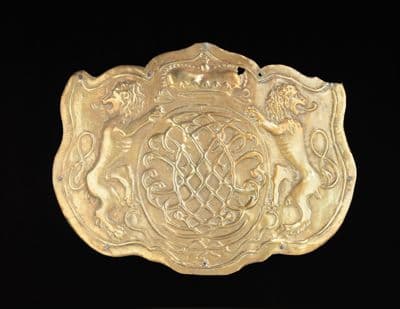
Technique·metalworkFunction·military-uniformMotif·heraldic
SHARED40 years · cross-culture · cross-category
This Austrian belt plate's baroque swirl of imperial eagles and heraldic flourishes speaks the same ornamental language as the American bicorne's gilded insignia, both pieces insisting that military authority requires theatrical display. The bicorne's oval medallion echoes the belt plate's central cartouche—forty years later, American officers were still borrowing Europe's vocabulary of embossed prestige, just scaled down from waist-spanning brass bombast to a discrete forehead whisper.
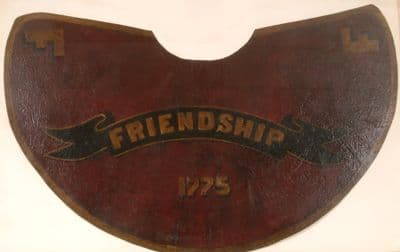
Function·military-uniformMotif·heraldic
SHARED30 years · cross-category
Text62%
Echoes Across Time
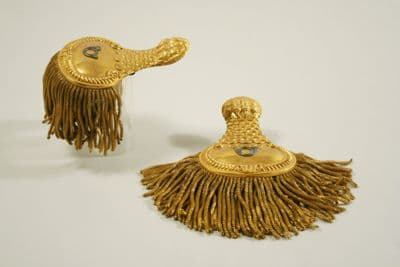
Empire / Regency → Victorian Late / Bustle · 70yr66%
SHARED
These pieces speak the same language of military pomp across seven decades and an ocean. The golden epaulets' cascading bullion fringe and the bicorne's elaborate gilt tassels both deploy that distinctly 19th-century logic where more ornament equals more authority—the kind of decorative excess that announced rank from across a parade ground.
Worn with·military dress uniformTechnique·metalworkFunction·military-uniform
Pull the Thread→
Follow this garment wherever the graph leads