THE MET
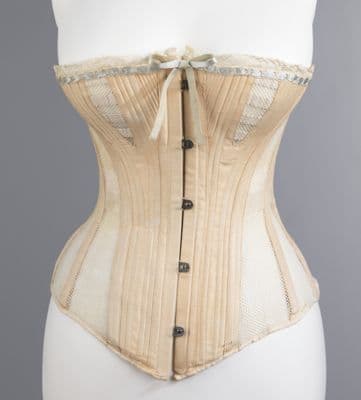
Cream Cotton Coutil Tight-Laced Victorian Corset
Victorian Late / Bustle · 1880s · American
Production
ready-to-wear
Material
cotton coutil
Culture
American
Influences
tight-lacing movement · hourglass silhouette ideal
This late Victorian corset demonstrates the extreme waist constriction fashionable in the 1880s. Constructed from cream-colored cotton coutil with pale pink ribbon trim, it features a distinctive curved silhouette that creates an hourglass figure. The front busk closure has multiple hook-and-eye fastenings, while the back would have laced tightly. Vertical steel boning channels are visible throughout, providing structural support for the dramatic waist reduction. The corset extends from just below the bust to the hips, with a slightly flared bottom edge. White cotton binding finishes the top and bottom edges, and delicate lace trim adorns the upper edge.
dresstight fithip length
Connected To
Worn with·bustleWorn with·chemiseWorn with·petticoat
SHAREDsame era · cross-culture · cross-category
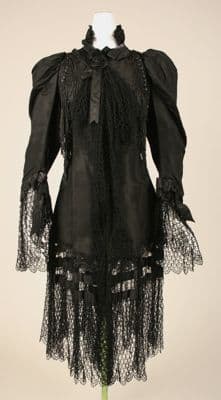
These garments reveal the Victorian woman's daily armor of respectability, one hidden and one displayed. The corset's brutal geometry—those steel bones radiating from the wasp waist, the back lacing pulled to anatomical extremes—created the foundation for the mourning coat's dramatic silhouette with its cascading black lace and exaggerated leg-of-mutton sleeves.
62%
Worn with·chemiseWorn with·dressWorn with·petticoat
SHARED50 years · cross-culture · cross-category
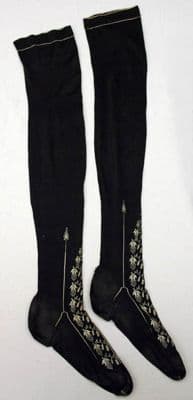
These pieces share the Victorian obsession with turning the hidden into art—the corset's meticulous boning channels and precise stitching mirror the stockings' delicate floral embroidery climbing up the leg like ivy. Both transform functional undergarments into objects of quiet seduction through obsessive craft: the corset's engineering creates an hourglass silhouette that would be glimpsed only in private moments, while the stockings' embroidered blooms would flash tantalizingly at the ankle.
Worn with·chemiseWorn with·dressWorn with·petticoat
SHARED60 years · cross-category
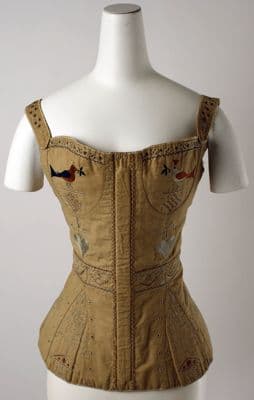
Both corsets speak the same structural language of cotton coutil and steel boning, but where the Victorian piece pursues the era's obsession with an impossibly cinched waist through its dramatic hourglass silhouette, the later romantic-era corset extends its grip downward over the hips in a longer, more forgiving line.
Worn with·chemiseWorn with·dressWorn with·petticoat
SHARED50 years · cross-category
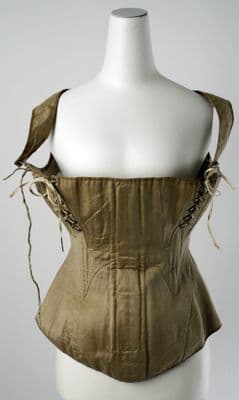
The Victorian corset's rigid geometry of steel bones and mathematical precision finds its romantic descendant in the olive green lace-up bodice, where the same waist-cinching imperative softens into something more like seduction than engineering. Where the cream coutil corset speaks in the language of proper foundation garments—hidden, structural, uncompromising—the green cotton twill version puts the corsetry on display, those shoulder ties and visible lacing turning underwear into outerwear.
Echoes Across Time
Victorian Late / Bustle → Romantic · 50yr62%
SHARED
These pieces share the Victorian obsession with turning the hidden into art—the corset's meticulous boning channels and precise stitching mirror the stockings' delicate floral embroidery climbing up the leg like ivy. Both transform functional undergarments into objects of quiet seduction through obsessive craft: the corset's engineering creates an hourglass silhouette that would be glimpsed only in private moments, while the stockings' embroidered blooms would flash tantalizingly at the ankle.
Worn with·chemiseWorn with·dressWorn with·petticoat
Pull the Thread→
Follow this garment wherever the graph leads