Victorian Late / Bustle · 1880s-1890s · American
Production
handmade
Material
cotton
Culture
American
Movement
Women's Suffrage Movement
Influences
Victorian day dress silhouette
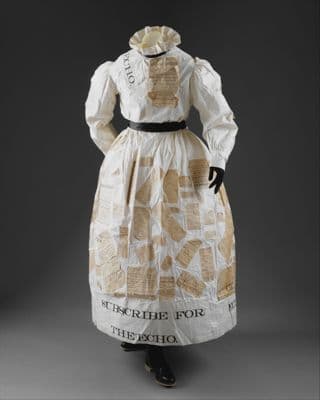
A white cotton dress with a fitted bodice featuring long sleeves with gathered shoulders and a high neckline with ruffled collar. The bodice is belted at the waist with a dark sash. The full skirt extends to ankle length and displays printed text and imagery in brown tones, appearing to be suffrage-related slogans and symbols. The garment combines the conventional Victorian silhouette of the 1880s with political messaging, transforming everyday dress into a vehicle for women's rights advocacy. The cotton fabric appears to be medium-weight with clear printing that would be visible during public demonstrations.


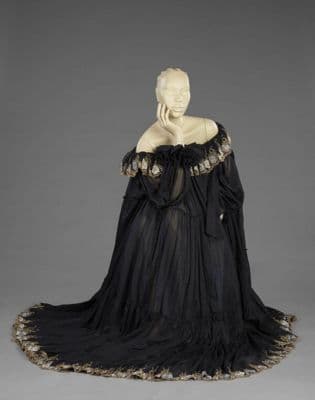
Both dresses use their sleeves as stages for drama, but they're performing opposite acts. The suffragette's white cotton declares its politics through printed text and militant practicality—those full sleeves and high neck armor her for the streets, not the salon. The contemporary mourning gown pulls its black silk sleeves down past the shoulders in a gesture of romantic vulnerability, its gold metallic trim catching light like tears.
Follow this garment wherever the graph leads
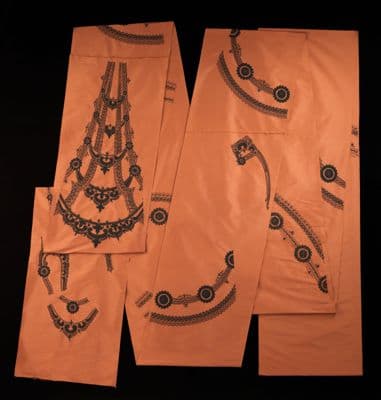
The suffragette's white cotton dress carries its politics literally on its sleeve, with "VOTES FOR WOMEN" block-printed across the fabric in bold letters that turn protest into pattern. A decade earlier, those coral silk pattern pieces reveal the same block-printing technique in service of pure decoration—delicate jewelry motifs and ornamental chains printed onto what would become an elegant French gown.
Both dresses use their sleeves as stages for drama, but they're performing opposite acts. The suffragette's white cotton declares its politics through printed text and militant practicality—those full sleeves and high neck armor her for the streets, not the salon. The contemporary mourning gown pulls its black silk sleeves down past the shoulders in a gesture of romantic vulnerability, its gold metallic trim catching light like tears.
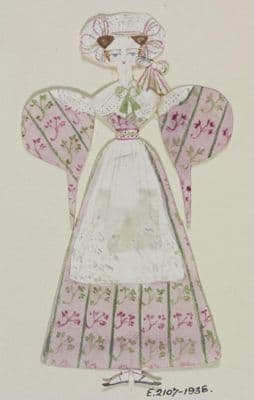
These two garments reveal how domestic femininity became a battlefield uniform. The suffragette's white cotton dress transforms the Victorian housewife's uniform—that same high collar, fitted bodice, and full skirt seen in the earlier watercolor—into militant messaging, with bold text declaring allegiance to "THE CAUSE" across what would have been safely decorative floral motifs.
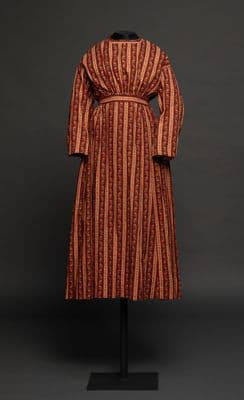
The white suffrage dress with its bold leaf motifs and protest text transforms the demure silhouette of 19th-century respectability into a billboard for political rebellion, while the rust-striped cotton dress forty years earlier represents the quieter defiance of enslaved women who claimed beauty and self-expression through careful pattern-matching and meticulous construction.


These two garments reveal how domestic femininity became a battlefield uniform. The suffragette's white cotton dress transforms the Victorian housewife's uniform—that same high collar, fitted bodice, and full skirt seen in the earlier watercolor—into militant messaging, with bold text declaring allegiance to "THE CAUSE" across what would have been safely decorative floral motifs.