V&A
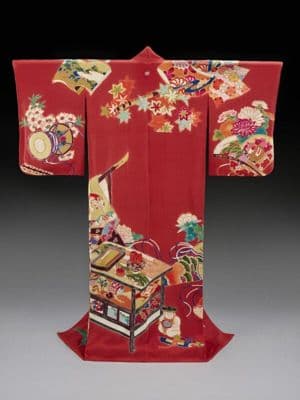
Deep Red Silk Crepe Visiting Kimono
1950s · 1950s · Japanese
Designer
Kimura Uzan
Production
artisan-craft
Material
silk crepe
Culture
Japanese
Movement
New Look / Post-War
This hōmogi displays the classic T-shaped kimono silhouette with wide rectangular sleeves and straight-line construction. The deep red silk crepe ground features elaborate pictorial motifs including decorative boxes, floral arrangements, and geometric patterns rendered in gold, cream, and green. The design elements are asymmetrically placed across the garment, with concentrated decoration on the lower portion and sleeves. The silk crepe fabric provides subtle texture and drape characteristic of mid-20th century Japanese textile production. Gold metallic threads create luminous highlights throughout the design, demonstrating sophisticated dyeing and embellishment techniques typical of Kanazawa's renowned textile craftsmanship during the post-war recovery period.
dressstraightfloor length
Connected To
Worn with·obiTechnique·resist-dyeing
SHARED60 years
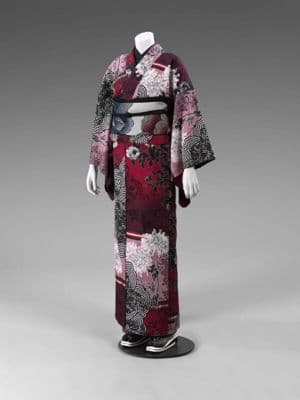
These two kimono speak the same visual language across six decades: that saturated red ground that makes everything else pop, and the way both designers scattered their motifs like confetti rather than marching them in orderly rows.
Pull the Thread→
Follow this garment wherever the graph leads