V&A
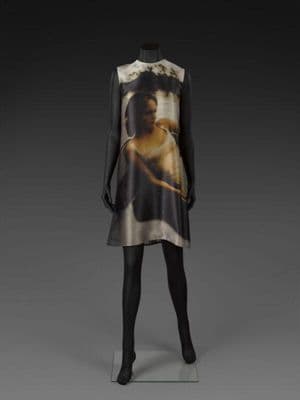
Black Silk Shift Dress with Digital Photo Print
1990s · 2010s · British
Designer
Glen Luchford
Production
ready-to-wear
Material
silk with digital photo print
Culture
British
Movement
Conceptual Fashion · Minimalism
Influences
classical painting reproduction · conceptual art fashion
A knee-length shift dress constructed from silk featuring a large-scale digital photographic print. The image appears to show a classical or Renaissance-style figure rendered in warm golden and brown tones against the black fabric ground. The dress has a simple, boxy silhouette with long sleeves and a straight hemline that falls just above the knee. The photographic print dominates the front panel of the garment, creating a striking visual impact through the juxtaposition of classical imagery on contemporary fashion. The construction appears minimal with clean seaming, allowing the printed image to serve as the primary design element. This represents the intersection of digital printing technology with high fashion conceptual design.
dressloose fitcrew neckabove-the-knee
Connected To

60%
Movement·Conceptual FashionFunction·avant-garde
SHAREDsame era · cross-culture
Both garments weaponize the mundane as high fashion, but through opposite strategies. The Nigerian ensemble takes the most basic of basics—a "HEAR ME" sweatshirt—and subverts it with an asymmetrical skirt that looks like it's been assembled from athletic pennants or protest banners, turning streetwear into a kind of wearable manifesto.
Pull the Thread→
Follow this garment wherever the graph leads