1960s · 1960s · British
Production
ready-to-wear
Material
pleated silk
Culture
British
Movement
Space Age · Mod
Influences
Japanese origami folding · Issey Miyake pleating techniques
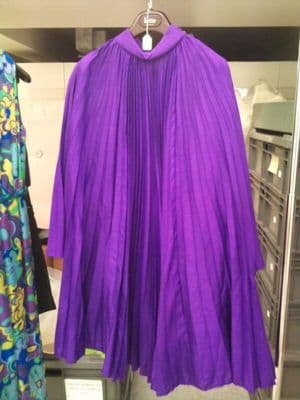
A vibrant purple cocktail dress featuring extensive knife pleating throughout the entire garment. The dress displays a dramatic tent silhouette that falls from a high neckline to what appears to be knee or midi length. The pleating creates vertical ridges that catch light and shadow, giving the silk fabric dimensional texture and movement. The high mock neckline and long sleeves create a modest coverage that contrasts with the voluminous, free-flowing body. This construction exemplifies 1960s Space Age design principles, where geometric manipulation of fabric replaced traditional fitted tailoring. The intense purple hue and architectural pleating technique demonstrate the era's embrace of synthetic dyes and industrial textile processes applied to luxury materials.
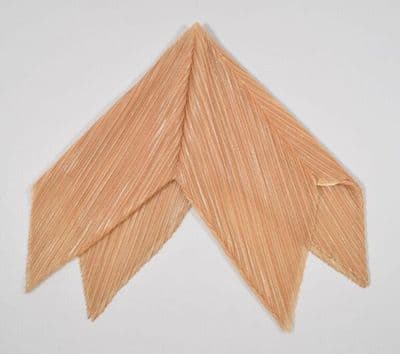
The coral collar's knife-sharp pleats and architectural geometry echo the theatrical cascade of the purple tent dress, both mining the same vein of pleating as pure sculptural expression. Thirty years separate them, but they share Miyake's revolutionary understanding that fabric manipulation could create form without seams—the collar reads like a distilled fragment of the dress's enveloping drama.
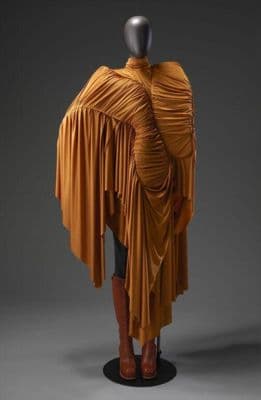
The burnt orange dress's cascading asymmetrical folds and the purple tent's knife-sharp pleats both spring from the same well: a fascination with fabric as sculptural material that can hold impossible shapes through sheer engineering. Sixty years separate them, but both designers understood that the real drama happens when cloth defies gravity—whether through the orange dress's waterfall of draped jersey or the purple's accordion precision that transforms the body into a geometric abstraction.


Follow this garment wherever the graph leads
The burnt orange dress's cascading asymmetrical folds and the purple tent's knife-sharp pleats both spring from the same well: a fascination with fabric as sculptural material that can hold impossible shapes through sheer engineering. Sixty years separate them, but both designers understood that the real drama happens when cloth defies gravity—whether through the orange dress's waterfall of draped jersey or the purple's accordion precision that transforms the body into a geometric abstraction.
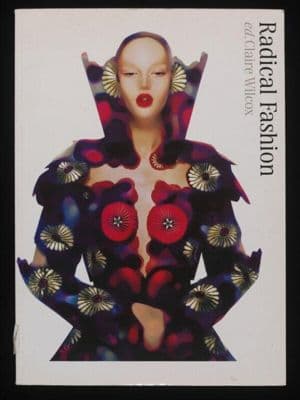
That avant-garde jacket with its sharp-angled lapels jutting like geometric wings shares DNA with the purple tent dress's accordion pleats — both garments treat fabric as architecture, folding it into sculptural forms that expand beyond the body's natural silhouette. The jacket's origami-inspired construction, with its precise creases creating dramatic shoulder projections, echoes the same Japanese folding principles that give the 1960s dress its voluminous, pleated structure.
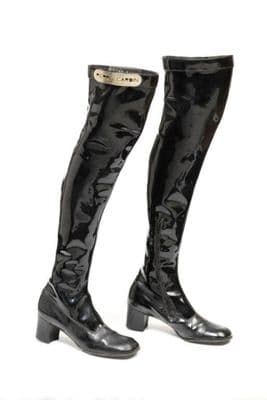
These pieces capture the Space Age moment when fashion went full sci-fi fantasy, but they show two different routes to the future. The boots, with their mirror-black PVC and architectural thigh-high silhouette, are all hard surfaces and geometric precision—they could have walked off a Courrèges runway or out of *2001: A Space Odyssey*.
That avant-garde jacket with its sharp-angled lapels jutting like geometric wings shares DNA with the purple tent dress's accordion pleats — both garments treat fabric as architecture, folding it into sculptural forms that expand beyond the body's natural silhouette. The jacket's origami-inspired construction, with its precise creases creating dramatic shoulder projections, echoes the same Japanese folding principles that give the 1960s dress its voluminous, pleated structure.