V&A
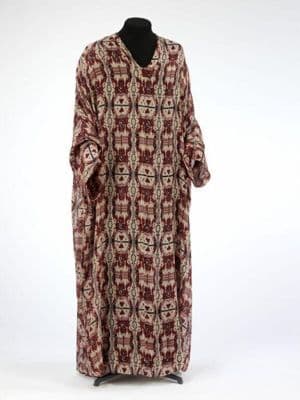
Burgundy Cream Geometric Print Silk Kaftan
1970s · 1970s · British
Designer
Mr Fish
Production
ready-to-wear
Material
printed silk
Culture
British
Movement
Counterculture · Hippie / Counterculture
Influences
Middle Eastern kaftan · 1960s psychedelic prints
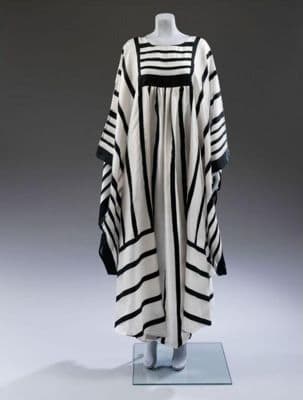
A floor-length kaftan constructed from lightweight printed silk featuring an all-over geometric medallion pattern in burgundy and cream tones. The garment displays a loose, flowing silhouette with wide kimono-style sleeves and a deep V-neckline. The fabric drapes freely from the shoulders without waist definition, creating an unstructured, relaxed fit typical of 1970s leisure wear. The repeating circular motifs appear to be machine-printed in a symmetrical grid layout across the entire surface. The kaftan represents the era's embrace of non-Western garment forms and psychedelic-influenced textile designs, reflecting both the counterculture movement's interest in Eastern aesthetics and the period's bold approach to pattern and color in fashion.
dresstentv-neckfloor length
Connected To
Influences·Middle Eastern kaftanMovement·Hippie / Counterculture
VISUAL ECHOsame era · cross-culture
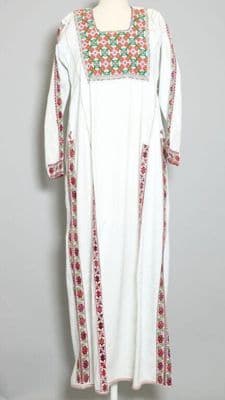
These two kaftans reveal how the 1970s counterculture movement created an unlikely visual convergence between Palestinian embroidery traditions and British textile printing. The Israeli kaftan's hand-stitched geometric florals across the chest and sleeves echo the same diamond-and-cross motifs that appear in the British kaftan's all-over silk print—one painstakingly embroidered in the ancient Palestinian tatreez style, the other mass-produced through Western printing techniques.
Pull the Thread→
Follow this garment wherever the graph leads