V&A
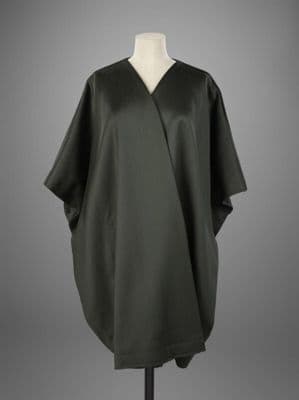
Forest Green Wool Cotton Oversized Abaya Jacket
2020s · 2010s · Lebanese
Designer
Nour Hage
Production
artisan-craft
Material
wool and cotton blend
Culture
Lebanese
Movement
Contemporary Islamic Fashion · Cottagecore
Influences
traditional Middle Eastern aba · Japanese kimono silhouette
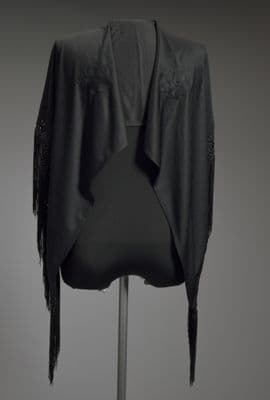
This contemporary jacket reinterprets the traditional Middle Eastern aba through a modern minimalist lens. The garment features a deep forest green wool-cotton blend in a dramatically oversized cocoon silhouette. The construction shows clean geometric lines with wide kimono-style sleeves that create a cape-like drape. The V-neckline is deep and angular, while the hemline falls asymmetrically with curved edges. The fabric appears to have a matte finish with substantial weight that allows the garment to hold its sculptural shape. The piece demonstrates how traditional Middle Eastern robing can be translated into contemporary fashion through simplified construction and modern proportions.
coatoversizedv-neckknee length
Connected To
Influences·Japanese kimono silhouette
SHARED20 years · cross-culture
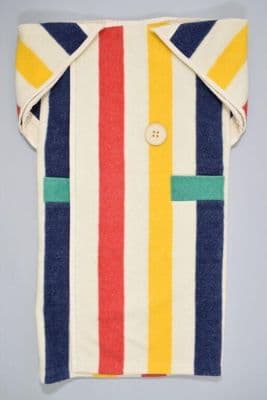
Both garments surrender to the kimono's radical proposition: that a sleeve can be a wall, that a body can disappear into geometry. The 1990s blanket coat treats this borrowed silhouette as pure theater—those carnival stripes and dramatically flared sleeves turning the wearer into a walking Mondrian—while the forest green piece three decades later strips away the performance, finding power in the kimono's original restraint.
Pull the Thread→
Follow this garment wherever the graph leads