1950s · 1950s · British
Designer
Roecliff & Chapman and Marcus
Production
ready-to-wear
Culture
British
Movement
New Look · New Look / Post-War
Influences
Christian Dior New Look silhouette
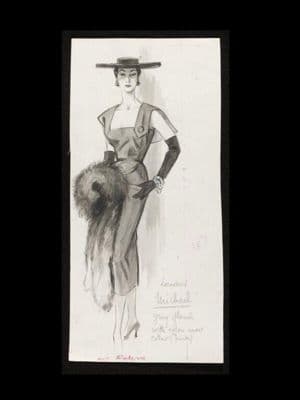
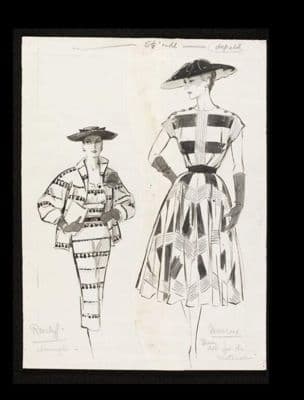
Fashion illustration showing two women's day dresses from the early 1950s. The left figure wears a horizontally striped dress with three-quarter sleeves and a fitted silhouette that extends to mid-calf length. The right figure displays a dress with bold geometric patterns featuring large triangular or diamond shapes across the bodice and skirt. Both garments demonstrate the New Look silhouette with nipped waists and full skirts that fall below the knee. The illustration style is characteristic of 1950s fashion drawing with confident black ink strokes and simplified forms. Both women wear small hats typical of the period, and the overall aesthetic reflects the optimistic, feminine fashion revival of post-war Britain.
Follow this garment wherever the graph leads
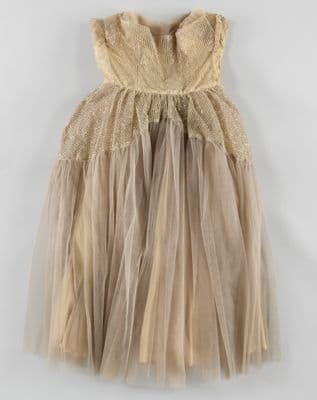
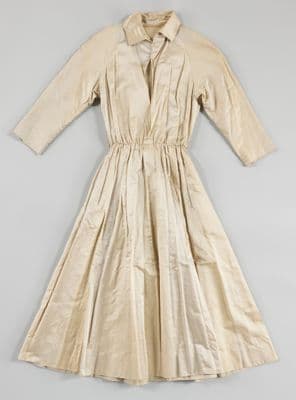
The sketch's bold stripes and the cream dress's subtle sheen represent two sides of the same post-war coin: both embrace Dior's New Look wasp waist and full circle skirt, but where the illustrated designs announce their modernity through graphic pattern, the acetate dress whispers it through synthetic fabric that promised easy care for the newly suburban housewife.
Both dresses spring from Dior's New Look revolution, but they capture different moments in its evolution—the sketch shows the silhouette in its most graphic, almost architectural form with those bold horizontal stripes that emphasize the cinched waist and full skirt, while the cream tulle number translates that same DNA into something softer and more romantic.
These sketches capture the New Look's essential grammar in two different dialects — the French design speaks in the fluid cursive of draped silk crepe that pools and gathers around the body, while the British pair articulates the same hourglass message through crisp horizontal stripes that slice across fitted bodices and full skirts.
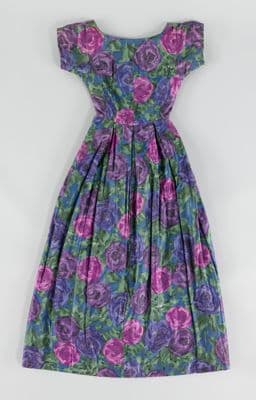
These two 1950s dresses reveal how Dior's New Look became a universal language, translating across continents while maintaining its essential grammar of cinched waist and full skirt. The British striped version, rendered in stark black and white with that crisp geometric precision, feels almost architectural next to the American floral's lush purple roses blooming across cotton sateen—one interprets the silhouette as modernist discipline, the other as romantic abundance.