V&A
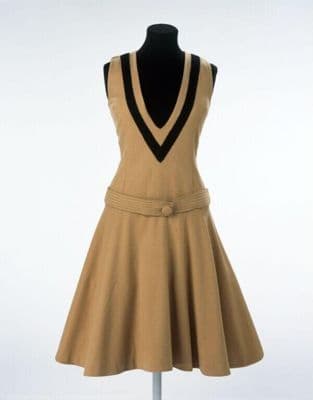
Brown Wool Shift Dress with Black Geometric Trim
1960s · 1960s · British
Designer
Mary Quant
Production
ready-to-wear
Material
wool
Culture
British
Movement
Mod · Space Age
Influences
mod geometric styling · dropped waist 1920s revival
A sleeveless day dress featuring a deep V-neckline with contrasting black trim that creates bold geometric lines against the camel-colored wool. The bodice fits closely to the torso and transitions to a dropped waist marked by a matching fabric belt with a simple round buckle. From this low waistline, the skirt flares out in a full circle, creating an A-line silhouette that falls to mid-calf length. The construction appears to use medium-weight wool with clean, architectural seaming. The stark contrast between the warm brown base and black trim exemplifies the graphic sensibility of early 1960s mod design, while the sleeveless cut and geometric proportions reflect the decade's move toward simplified, youth-oriented fashion.
dressa-linev-neckknee length
Connected To
63%
Movement·ModMovement·Space Age
SHAREDsame era · cross-culture
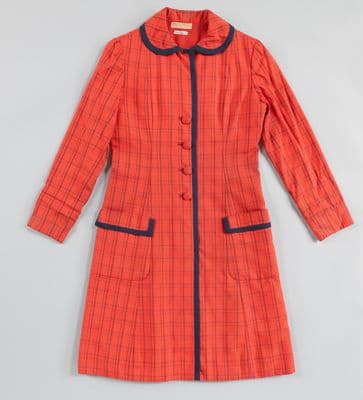
Both pieces pulse with that mid-60s mania for graphic contrast—the camel dress slicing its neckline with bold black chevrons, the red coat dress marching navy windowpane checks across its surface like a Pop Art grid. The camel number plays the mod game through pure geometry, using black trim as architectural punctuation on its A-line silhouette, while the coat dress achieves the same visual jolt through all-over pattern that turns the body into a walking Op Art experiment.
Echoes Across Time
Pull the Thread→
Follow this garment wherever the graph leads