Fin de Siecle / Gibson Girl · 1890s · French
Production
haute couture
Material
silk velvet
Culture
French
Influences
leg-of-mutton sleeve · military braiding
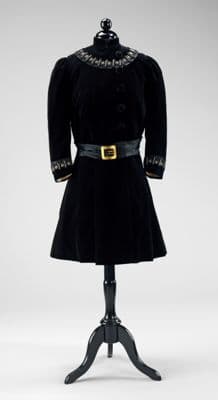
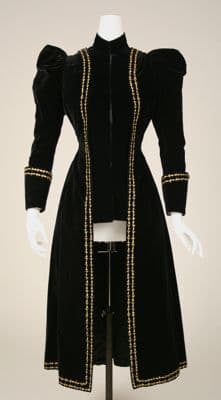
This black silk velvet jacket exemplifies 1890s silhouette with dramatically puffed sleeves that taper to fitted cuffs. The body follows the corseted torso closely, extending to mid-thigh length with a subtle flare. Gold braided trim outlines the front opening, cuffs, and hem in parallel lines, creating vertical emphasis. The high neckline features a standing collar, while the sleeves demonstrate the period's characteristic leg-of-mutton shape with maximum volume at the shoulder. The jacket's construction shows precise tailoring typical of French couture, with the trim applied in geometric patterns that enhance the garment's structured formality.


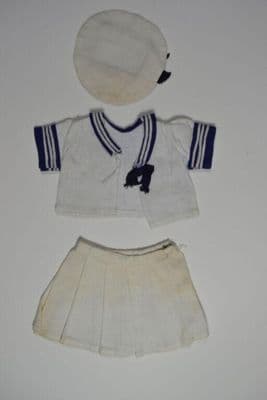
The black velvet jacket's military-inspired gold braiding finds its echo in the sailor suit's navy trim, both garments borrowing from naval uniforms but for entirely different reasons. The 1890s walking jacket appropriates masculine military authority for the New Woman, while the 1950s child's outfit romanticizes the same naval codes into innocent play-dress fantasy.


Follow this garment wherever the graph leads
These two black velvet pieces reveal how the military aesthetic infiltrated women's fashion across the Atlantic at the turn of the century. The American coat's regimental gold braiding and brass buckled belt echo the French jacket's precise rows of metallic trim and structured silhouette, both channeling the era's fascination with martial authority as women pushed against domestic boundaries.
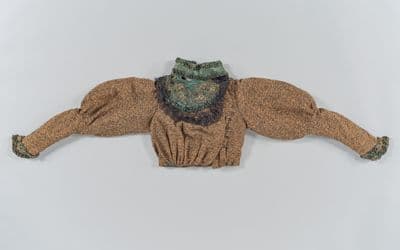
These two garments reveal how the Gibson Girl's signature ballooning sleeves crossed every social boundary at the fin de siècle, from the French couture salon to the African American seamstress's workroom. The black velvet jacket's military precision—that crisp gold braid marching down the front and circling the cuffs—speaks to wealth and European refinement, while the brown wool bodice achieves the same dramatic sleeve volume through clever gathering and a more modest green silk collar detail.
The black velvet jacket's military-inspired gold braiding finds its echo in the sailor suit's navy trim, both garments borrowing from naval uniforms but for entirely different reasons. The 1890s walking jacket appropriates masculine military authority for the New Woman, while the 1950s child's outfit romanticizes the same naval codes into innocent play-dress fantasy.
These two pieces capture the exact moment when Victorian formality cracked open. The black velvet jacket, with its military-precise gold braiding and leg-of-mutton sleeves, represents the Gibson Girl's last stand—all that structured drama demanding a corset's architecture beneath.